Video KYC: How Digital Identity Verification Is Transforming Customer Onboarding in India
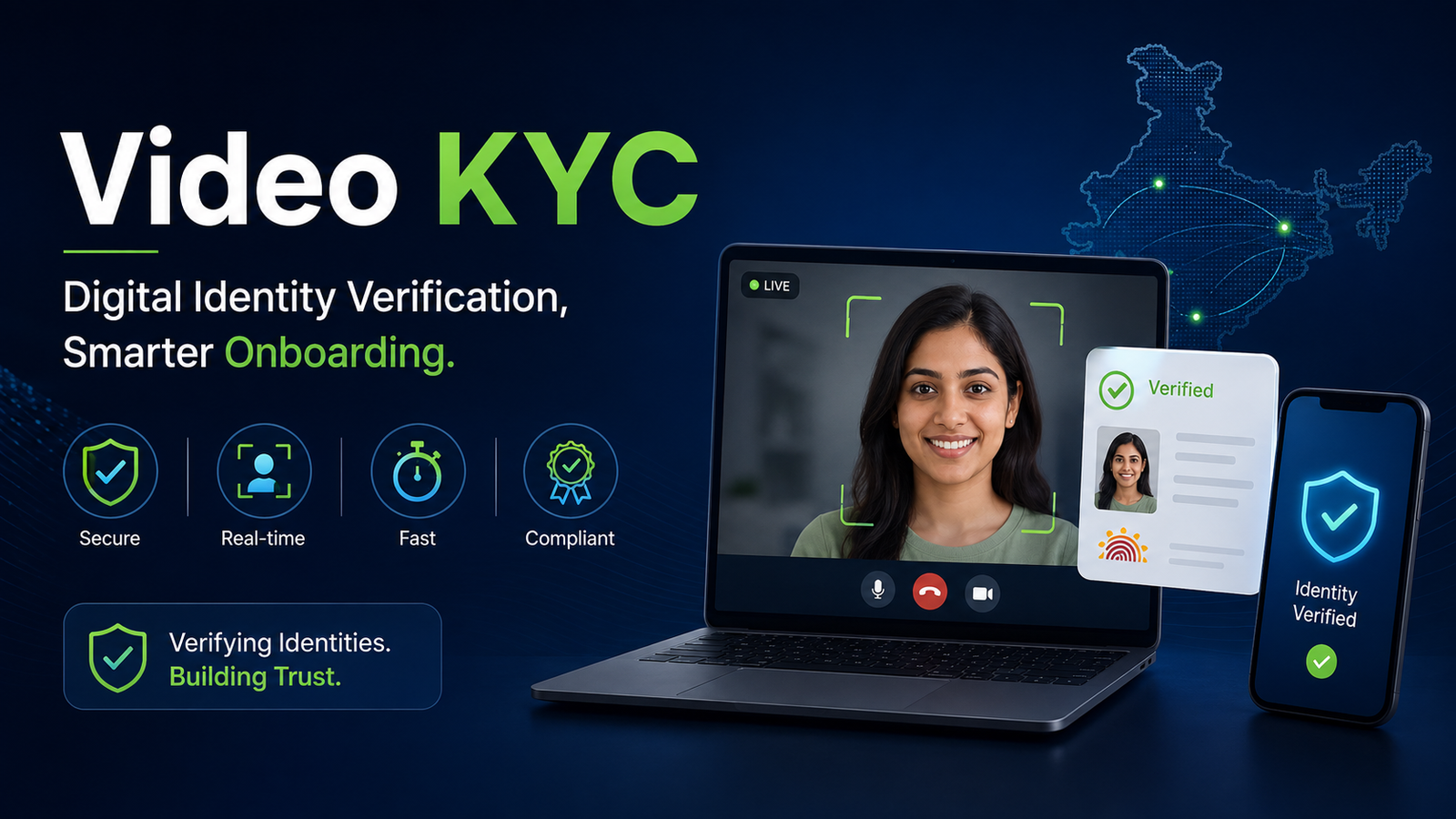
"Video KYC is transforming customer onboarding by enabling remote identity verification through secure, live audiovisual interactions. This article explores how Video KYC works, the role of AI, face matching and liveness detection, key security and compliance considerations, common fraud risks, and how organizations can build a reliable digital identity-verification framework."
Video KYC: How Digital Identity Verification Is Transforming Customer Onboarding in India
Customer onboarding has changed dramatically.
A process that once required customers to visit a branch, submit physical documents, and wait for manual verification can now be completed through a digital interface.
One of the technologies driving this transformation is Video KYC, formally referred to in the banking regulatory framework as Video-based Customer Identification Process (V-CIP).
For banks, financial institutions, fintech companies, insurance businesses, lending platforms, and other regulated entities, Video KYC can provide a way to establish customer identity remotely while maintaining a structured identification and due-diligence process.
But Video KYC is much more than a video call.
A compliant and reliable Video KYC process combines live interaction, identity verification, document validation, liveness detection, audit trails, security controls, and trained verification personnel.
So, how does it work, what risks does it address, and what should organizations consider before implementing it?
What Is Video KYC?
Video KYC is a digital customer identification process that allows an authorized official of a regulated entity to verify a customer's identity through a live, consent-based audio-visual interaction.
Under the Reserve Bank of India's KYC framework, V-CIP is treated as an alternative method of customer identification and, when conducted according to the prescribed requirements, can be treated on par with face-to-face Customer Identification Process (CIP).
Instead of requiring the customer to physically visit a branch, the process can use technology to establish identity remotely.
A typical Video KYC workflow may involve:
Customer initiates onboarding
↓
Consent is obtained
↓
Identity information is collected
↓
Live video interaction begins
↓
Document and identity details are verified
↓
Liveness and face matching are performed
↓
Verification officer completes the assessment
↓
Records and audit trail are maintained
↓
Customer onboarding is completed, subject to applicable requirements
Why Video KYC Matters
Traditional customer onboarding can be time-consuming.
Customers may have to:
- Visit a branch
- Carry physical documents
- Wait for verification
- Complete multiple forms
- Coordinate with customer-service teams
Video KYC can reduce some of these friction points by allowing remote interaction.
For digital-first businesses, this can be particularly valuable.
A customer could potentially begin an account-opening or financial-service journey online and complete the required identity verification without visiting a physical location.
This can improve:
- Onboarding convenience
- Operational efficiency
- Customer experience
- Geographic reach
- Verification visibility
However, convenience cannot come at the cost of identity assurance.
Video KYC Is Not Just a Video Call
One of the biggest misconceptions about Video KYC is that it simply means talking to a customer over video.
A robust V-CIP process is considerably more structured.
RBI's framework includes requirements around secure audiovisual interaction, informed consent, identity/document verification, live location, liveness checks, trained officials, recording and audit trails, among other controls.
The objective is to answer a fundamental question:
Is the person appearing on the screen genuinely the person whose identity is being established?
That requires more than seeing a face on a camera.
How Does Video KYC Work?
While exact workflows can vary by regulated entity and applicable requirements, the process generally involves several stages.
1. Customer Initiates the Process
The customer begins the digital onboarding process.
Basic information may be collected before the video interaction begins.
The organization can then initiate the V-CIP workflow according to its approved process.
2. Customer Consent
Consent is an important component of the process.
The customer should understand that an audiovisual interaction is being conducted for identification and due-diligence purposes.
RBI's framework describes V-CIP as an informed-consent-based process.
This means the video interaction should not simply happen without the customer knowing its purpose.
3. Live Video Interaction
An authorized official conducts the interaction.
The purpose is to establish that:
- The customer is physically present
- The interaction is live
- The person matches the relevant identity information
- The information provided is consistent
The official may ask questions or request specific actions during the interaction.
The sequence or type of questions may be varied to help establish that the interaction is real-time rather than a pre-recorded video.
4. Document Verification
Depending on the applicable framework and entity, identity information may be obtained through permitted sources such as Aadhaar-based methods, CKYCR information, or equivalent electronic Officially Valid Documents.
RBI's current framework also provides for use of equivalent e-documents, including documents issued through DigiLocker, subject to the applicable requirements.
The objective is to validate the information being presented rather than simply collect a document image.
5. PAN Verification
For applicable V-CIP processes, the regulated entity captures a clear image of the customer's PAN or uses e-PAN where permitted, and PAN details are verified against the issuing authority's database.
This creates another layer of independent validation.
6. Face Matching
The customer's live appearance can be compared with the photograph associated with the relevant identity document.
This helps answer:
Does the person on the video match the identity document?
Face matching technology can support this process, although technology does not eliminate the responsibility of the regulated entity to establish customer identity. RBI's framework explicitly allows the use of AI and face-matching technologies while retaining responsibility with the regulated entity.
7. Liveness Detection
A photograph or pre-recorded video can potentially be used to impersonate another person.
This creates a major challenge for remote identity verification.
Liveness detection is designed to help determine whether the person appearing in front of the camera is a live individual rather than a static image, recording, or certain forms of spoofing.
RBI's V-CIP requirements include liveness and spoof-detection capabilities.
This is particularly important as synthetic media and deepfake technologies become increasingly sophisticated.
8. Geotagging and Location Validation
For applicable V-CIP processes, live location information is captured to help establish the customer's physical presence in India.
RBI's framework specifies live GPS coordinates/geotagging and requirements relating to the customer's location during V-CIP.
This creates another layer of assurance beyond the video interaction itself.
9. Audit Trail and Recording
A reliable verification process needs evidence.
The V-CIP framework requires preservation of relevant records and video recordings, including appropriate timestamps and audit information.
This can help organizations:
- Demonstrate how identification was performed
- Investigate disputes
- Review suspicious cases
- Support audits
- Strengthen accountability
An audit trail transforms the process from an informal video interaction into a structured verification activity.
Why Liveness Matters More in the Age of AI
Video KYC has evolved alongside digital fraud.
Today, fraudsters have access to increasingly sophisticated technologies that can manipulate:
- Faces
- Voices
- Videos
- Documents
- Identity information
This creates a new challenge for remote verification.
A system that only asks:
“Does this face look like the photograph?”
may not be sufficient.
Modern verification needs to consider:
Is the person real?
Is the interaction live?
Is the document genuine?
Does the identity information match?
Is the person physically where they are expected to be?
Is there evidence of manipulation or spoofing?
This is why liveness detection, face matching, document validation and human review can work together as multiple layers of identity assurance.
The Human Element Still Matters
Technology can perform many verification tasks.
But Video KYC should not be viewed as a completely automated process.
RBI's framework requires V-CIP to be operated by specially trained officials of the regulated entity, with the official responsible for identifying fraudulent manipulation or suspicious conduct.
This creates a useful model:
Technology
Detects patterns and anomalies.
Verification Official
Interacts with the customer and assesses the situation.
Compliance Framework
Defines how the process should operate.
Audit Trail
Provides evidence of what happened.
The combination is stronger than relying on any single layer.
Common Risks in Video KYC
Despite its advantages, Video KYC comes with its own risks.
1. Deepfake and Synthetic Identity Fraud
AI-generated faces and manipulated video can make impersonation more difficult to detect.
Organizations therefore need strong liveness and spoof-detection capabilities.
2. Document Manipulation
A fraudster may attempt to present:
- Altered documents
- Edited images
- Fake identity documents
- Screenshots
- Reproduced digital records
Document verification should therefore be integrated into the broader identity-assurance process.
3. Identity Mismatch
A person may present another individual's document.
Face matching and human verification can help detect inconsistencies.
4. Social Engineering
Fraud does not always depend on sophisticated technology.
A person may attempt to manipulate the verification official through:
- False explanations
- Prompting
- Coaching
- Someone else providing answers
- Concealing information
This is one reason trained verification personnel remain important.
5. Data Security
Video KYC generates sensitive information.
This may include:
- Identity data
- Video recordings
- Photographs
- Documents
- Location information
- Customer details
Protecting this information is therefore critical.
Security Should Be Built Into the Architecture
Video KYC is only as strong as the infrastructure supporting it.
RBI's V-CIP framework includes requirements around secure infrastructure, end-to-end encryption, application testing, security audits, data ownership and storage, and other controls.
Organizations should therefore consider:
- Encryption
- Secure application architecture
- Access controls
- Secure storage
- API security
- Vulnerability testing
- Penetration testing
- Security audits
- Monitoring
- Incident management
The objective is to protect the identity data during collection, transmission, processing, and storage.
Video KYC and Compliance
For regulated entities, Video KYC is not simply a customer-experience feature.
It operates within a broader KYC and Customer Due Diligence framework.
RBI's current KYC framework continues to recognize V-CIP as a method of customer identification and includes detailed requirements for infrastructure, procedures, records, security, liveness, identity verification and auditability.
The regulatory environment can evolve, so organizations should always design and operate their V-CIP processes against the latest applicable requirements rather than relying on outdated checklists.
Video KYC vs Traditional KYC
| Factor | Traditional / Physical KYC | Video KYC |
|---|---|---|
| Customer presence | Physical | Remote |
| Verification channel | In-person | Live audiovisual interaction |
| Geographic reach | Limited by physical locations | Greater digital reach |
| Document handling | Physical/digital | Digital |
| Liveness assessment | Human observation | Technology + human interaction |
| Audit trail | Physical/digital records | Digital records + video |
| Customer convenience | Relatively lower | Generally higher |
| Technology dependency | Moderate | High |
The objective isn't necessarily to eliminate traditional methods.
Instead, Video KYC provides an important digital alternative where permitted and appropriately implemented.
The Business Benefits of Video KYC
-
Faster Customer Onboarding
Digital verification can reduce dependence on physical branch visits.
-
Wider Customer Reach
Organizations can serve customers beyond their physical locations.
-
Better Customer Experience
Customers can complete verification remotely.
-
Greater Process Visibility
Digital workflows can make verification status easier to track.
-
Reduced Manual Administration
Automation can reduce repetitive tasks.
-
Stronger Auditability
Digital records can create a clearer verification trail.
-
Scalable Operations
Technology can help organizations process larger volumes without proportionally increasing manual workload.
What Organizations Should Look for in a Video KYC Solution
Before implementing a Video KYC platform, organizations should evaluate more than the quality of the video call.
Important considerations include:
Identity Verification
Can the platform validate identity information reliably?
Face Matching
Can it compare the live customer with the relevant document photograph?
Liveness Detection
Can it detect common spoofing attempts?
Document Verification
Can it identify suspicious or manipulated documents?
Geolocation
Can the process capture required location information?
Security
Is data protected through appropriate encryption and access controls?
Auditability
Can the organization reconstruct what happened during a verification session?
Scalability
Can the platform handle high customer volumes?
Integration
Can it connect with existing onboarding, KYC and compliance systems?
Human Review
Can suspicious or ambiguous cases be escalated to trained personnel?
The Role of AI in Video KYC
AI can significantly strengthen digital identity verification.
Potential applications include:
- Face matching
- Liveness detection
- Document analysis
- Anomaly detection
- Spoof detection
- Image-quality assessment
- Risk scoring
- Automated workflow routing
However, AI should be treated as a verification support layer, not as an excuse to remove governance.
A strong architecture can follow:
AI Detection
↓
Risk Assessment
↓
Human Review Where Required
↓
Final Decision
This approach can combine technological efficiency with human oversight.
Video KYC Is Also a Fraud-Prevention Tool
The value of Video KYC goes beyond onboarding speed.
It can help organizations address identity-related risks before a customer relationship is established.
Instead of relying on:
Document → Approval
organizations can create a multi-layer process:
- Document
- Identity
- Face
- Liveness
- Location
- Human Interaction
- Audit Trail
The more intelligently these layers work together, the stronger the overall identity-assurance process can become.
What the Future of Video KYC Looks Like
The next generation of digital KYC will likely become more intelligent and increasingly automated.
We can expect greater integration between:
- AI
- Facial recognition
- Liveness detection
- Document intelligence
- Digital identity
- Risk analytics
- Fraud detection
- Automated workflows
But increased automation will also require stronger governance.
The future isn't simply:
“Can we verify a customer through video?”
It is:
“Can we establish identity remotely with sufficient confidence, security, transparency, and auditability?”
That is the real challenge.
Final Takeaway
Video KYC has changed the way organizations can approach remote customer identification.
It can reduce friction, expand digital reach, improve onboarding experiences, and create a more structured verification process.
But a video call alone does not create trust.
A reliable Video KYC framework requires multiple layers:
Secure technology
Identity verification
Document validation
Face matching
Liveness detection
Location validation
Trained verification officials
Audit trails
Data security
Regulatory compliance
As digital fraud becomes more sophisticated, organizations need to move beyond simply asking whether a customer appears genuine on screen.
They need to build a verification process capable of determining whether the person, identity, document, and interaction all align.
In digital onboarding, seeing the customer is not enough. The goal is to verify the identity behind the screen.