57% Say Hiring Speed Is Compromising Background Verification: Are Companies Hiring Too Fast?
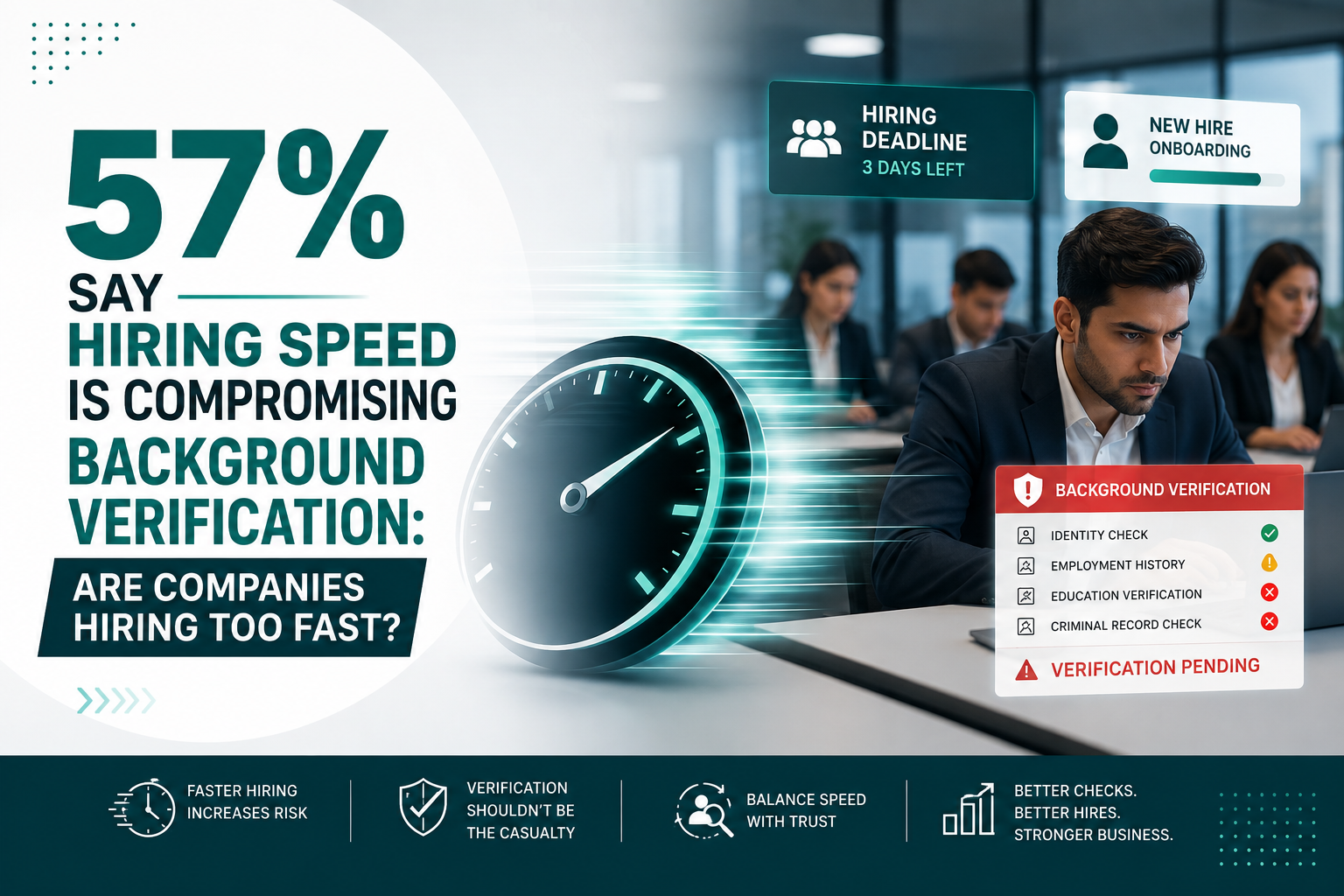
"A 2026 report based on responses from 1,647 HR professionals and business leaders found that 57% of respondents believe organizations frequently compromise background verification standards to accelerate hiring. As companies race to reduce time-to-hire, this creates a critical question: can businesses hire faster without increasing workforce risk? Explore how technology, risk-based verification, automation, and smarter workflows can help organizations balance hiring speed with trust."
57% Say Hiring Speed Is Compromising Background Verification: Are Companies Hiring Too Fast?
Hiring has changed dramatically.
Companies are competing for skilled talent, candidates expect faster decisions, and recruiters are under constant pressure to reduce time-to-hire. In many industries, the ability to move from interview to offer to onboarding quickly can make a significant difference.
But there is another side to this race for speed.
Are organizations moving so quickly that they are compromising the very checks designed to protect them?
A 2026 report by Genius HRTech, titled Hiring Blind – Are Organisations Ignoring Background Verification Risks?, raises exactly this concern. Based on responses from 1,647 HR professionals and business leaders, the report found that 57% of respondents believe organizations frequently compromise background verification standards in favour of faster hiring timelines.
That number should make every HR and business leader pause.
Because the real question is not whether companies should hire faster.
The question is:
Can companies hire faster without hiring blind?
The Hiring-Speed Dilemma
Recruitment teams are increasingly measured on speed.
Metrics such as:
-
Time-to-hire
-
Time-to-fill
-
Offer-to-joining ratio
-
Candidate conversion
-
Recruitment cost
-
Hiring volume
have become important indicators of recruitment performance.
When a critical position remains vacant, the business may lose productivity, revenue opportunities, customer capacity, or project momentum.
This creates pressure on recruiters to move candidates through the pipeline quickly.
But background verification often happens toward the end of the hiring process.
That creates a potential conflict:
Recruitment wants speed.
Risk and compliance want certainty.
The business wants both.
The challenge is finding a verification model that supports faster hiring without removing essential due diligence.
What Does the 57% Figure Actually Tell Us?
The statistic does not mean that 57% of organizations completely skip background verification.
More precisely, the report says 57% of respondents believe organizations frequently compromise BGV standards to meet faster hiring timelines.
That distinction matters.
Compromising verification could take different forms, such as:
-
Reducing the number of checks
-
Delaying verification until after joining
-
Relying heavily on candidate-provided documents
-
Accepting incomplete verification
-
Prioritizing speed over resolving discrepancies
-
Using fragmented manual processes that leave gaps
-
Taking a one-size-fits-all approach to verification
The underlying issue is the same:
The hiring clock may be moving faster than the verification process.
Why Are Companies Hiring Faster?
There are several reasons behind the growing pressure for speed.
1. Competition for Skilled Talent
When highly skilled candidates receive multiple offers, organizations may have only a limited window to make a decision.
A lengthy recruitment process can cause candidates to move elsewhere.
2. Business-Critical Positions
Some vacancies directly affect:
-
Revenue
-
Customer delivery
-
Technology projects
-
Sales operations
-
Business expansion
-
Leadership continuity
The longer the vacancy remains open, the greater the potential business impact.
3. High-Volume Hiring
Organizations hiring hundreds or thousands of employees cannot always rely on highly manual verification processes.
Volume creates pressure on HR teams to process candidates quickly.
4. Gig and Temporary Workforce Growth
The workforce is becoming increasingly flexible.
Companies are hiring:
-
Contractors
-
Freelancers
-
Gig workers
-
Temporary employees
-
Consultants
-
Project-based professionals
High-volume onboarding can make verification more difficult.
The 2026 report found that 42% of respondents identified high-volume onboarding as the biggest verification challenge for gig or temporary workers.
5. Remote Hiring
Remote recruitment has expanded the distance between employers and candidates.
Organizations may never physically meet a candidate before employment begins.
That increases the importance of reliable identity and credential verification.
What Happens When Speed Wins Over Verification?
The immediate benefit of skipping or reducing verification may appear simple:
The candidate joins faster.
But the potential downstream costs can be much larger.
Consider a simplified scenario:
Fast hiring
→ Candidate joins quickly
→ Verification is incomplete
→ A discrepancy is discovered later
→ Investigation begins
→ Employee access may need to be restricted
→ Replacement hiring becomes necessary
→ Productivity is affected
→ Business risk increases
The organization may have saved a few days during recruitment while creating a problem that lasts weeks or months.
This is why background verification should not be viewed only as a recruitment cost.
It is a risk-management investment.
The Fraud Problem Is Not Going Away
The concern becomes more significant when we look at the other findings from the report.
According to the report, 33% of respondents said they had encountered fake or inflated educational credentials during verification, while another 33% reported identity or address-related inconsistencies.
These findings highlight an important reality:
The candidate profile cannot always be taken at face value.
A resume can look impressive.
A degree certificate can look authentic.
An employment history can appear consistent.
An address can seem legitimate.
But verification exists precisely because information presented during recruitment may require independent validation.
Employment Fraud Can Also Hide in Plain Sight
The report also found that 21% of respondents had identified cases of dual employment or moonlighting.
This becomes particularly relevant in remote and hybrid work environments.
An organization may hire someone expecting:
One employee → One employment relationship → Full-time commitment
But the reality could be more complicated.
This doesn't mean that every case of outside work is fraudulent or prohibited. Employment contracts and organizational policies differ.
The point is that organizations need visibility into information that is relevant to the role and their policies.
Without appropriate verification, organizations may discover material discrepancies only after onboarding.
The Gig Workforce Creates a Different Verification Challenge
Traditional employee verification is already complex.
Gig and temporary hiring can make it even more difficult.
The 2026 report found that 71% of respondents supported mandatory identity and criminal verification across gig platforms, reflecting concerns around customer safety, operational trust, and workforce accountability.
Gig workforce verification can involve challenges such as:
-
High-volume onboarding
-
Short joining timelines
-
Workers operating across multiple platforms
-
Identity verification
-
Document authenticity
-
Limited formal address documentation
-
Distributed workforce locations
This creates a fundamental challenge:
How do you verify thousands of workers without creating thousands of manual bottlenecks?
The Answer Isn't to Make Verification Slower
This is an important distinction.
The solution to rushed verification is not necessarily more manual processes.
In fact, adding more manual steps can make the problem worse.
Imagine a process involving:
Candidate submits documents
↓
HR emails verification team
↓
Verification team sends requests manually
↓
External source responds
↓
HR follows up
↓
Documents are reviewed manually
↓
Discrepancy is identified
↓
Candidate is contacted
↓
Additional documents are requested
↓
Final report is generated
This process can become slow very quickly.
The better question is:
How can organizations make verification faster without making it weaker?
Technology Can Help Close the Speed trust Gap
The 2026 report points toward technology as part of the solution.
Nearly 63% of respondents expect AI-driven identity verification, digital KYC, and continuous monitoring to become standard hiring practices within the next three years.
This suggests that the future of BGV may not be about choosing between:
Speed OR accuracy
but about using technology to achieve:
Speed AND stronger verification.
Technology can help organizations automate repetitive activities such as:
-
Candidate onboarding
-
Document collection
-
Identity checks
-
Verification workflows
-
Status tracking
-
Candidate reminders
-
Data matching
-
Report generation
-
Exception identification
The goal is to reduce administrative friction while preserving meaningful verification.
AI Should Assist Verification not replace Judgment
AI can potentially make verification workflows more efficient.
It can help identify:
-
Data inconsistencies
-
Document anomalies
-
Duplicate information
-
Unusual patterns
-
Potential identity mismatches
-
Verification priorities
But AI should not automatically decide that a candidate is fraudulent.
For example:
Name mismatch ≠ fraud
Address mismatch ≠ fraud
Employment-date discrepancy ≠ fraud
A mismatch may have a legitimate explanation.
Human review remains important when a finding could materially affect a candidate's employment opportunity.
The future should therefore be:
AI-assisted verification + human oversight
rather than:
AI-only hiring decisions.
Not Every Candidate Needs the Same Verification
Another way organizations can improve speed without compromising risk management is to move away from a one-size-fits-all approach.
Consider three roles.
Role A: Administrative Assistant
Limited system access.
Low financial authority.
Limited exposure to sensitive information.
Role B: Finance Manager
Access to financial information.
Greater decision-making authority.
Potential exposure to sensitive business data.
Role C: Cybersecurity Administrator
Privileged access to critical systems.
Potential access to highly sensitive information.
Clearly, these roles do not carry identical risk.
A risk-based verification model can align verification depth with:
Role + Access + Seniority + Industry + Geography + Risk Exposure
This allows organizations to focus deeper verification where it matters most.
The Real Cost of a Bad Hire
Hiring speed is measurable.
The cost of a bad hire is harder to calculate.
It can include:
Direct Costs
-
Recruitment replacement costs
-
Salary and benefits
-
Training expenses
-
Investigation costs
-
Legal or compliance expenses
Indirect Costs
-
Lost productivity
-
Team disruption
-
Management time
-
Customer impact
-
Reputational damage
-
Delayed projects
-
Reduced employee morale
The most important point is that these costs may continue long after the original hiring decision.
This makes one question extremely important:
How much time are we actually saving by reducing verification—and what risk are we accepting in return?
Speed Should Be Measured Differently
Organizations often measure verification by turnaround time.
For example:
“Can we complete this check within 48 hours?”
That's useful—but incomplete.
Organizations should also consider:
-
Verification completion rate
-
Discrepancy rate
-
False-positive rate
-
Candidate drop-off
-
Manual intervention rate
-
Average resolution time
-
Verification accuracy
-
Percentage of cases requiring escalation
The objective shouldn't simply be:
Complete more checks faster.
It should be:
Complete meaningful checks quickly and accurately.
What HR Leaders Can Do Now
Organizations don't have to choose between fast hiring and responsible verification.
Here are practical steps HR and compliance teams can take.
1. Identify Critical Verification Checks
Determine which checks are essential for each role.
Not every position requires the same verification package.
2. Start Verification Earlier
Don't wait until the final stage of recruitment if appropriate checks can begin earlier in the process.
3. Automate Repetitive Tasks
Use technology to reduce:
-
Manual data entry
-
Email follow-ups
-
Document chasing
-
Status tracking
-
Report preparation
4. Build Risk-Based Workflows
High-risk roles can receive deeper verification while lower-risk roles can follow proportionate workflows.
5. Create an Exception Management Process
Not every case should receive the same manual attention.
Use technology to identify cases that genuinely require human review.
6. Track Verification Metrics
Measure verification performance alongside recruitment metrics.
7. Review the Process Regularly
Fraud patterns, technology, workforce models, and regulatory expectations continue to change.
Your verification strategy should change with them.
The Future: Faster Verification, Not Weaker Verification
The hiring landscape is moving toward greater speed, flexibility, and digitalization.
At the same time, fraud risks are becoming more sophisticated.
Organizations are dealing with:
-
Fake credentials
-
Identity inconsistencies
-
Remote hiring
-
Gig workforce risks
-
Document manipulation
-
Dual employment concerns
-
Increasingly digital candidate journeys
The answer cannot be to slow recruitment dramatically.
Nor should it be to eliminate meaningful verification.
Instead, organizations need to build verification into the hiring workflow rather than treating it as an obstacle at the end of recruitment.
That means:
Digital onboarding
→ Automated verification
→ Real-time status visibility
→ Risk-based checks
→ Exception management
→ Human review where necessary
→ Faster, more informed hiring
So, Are Companies Hiring Too Fast?
Maybe the better question is:
Are companies trying to hire faster than their verification processes can support?
The 57% finding suggests that this tension is already being felt by HR and business leaders.
Hiring speed is valuable.
But speed without sufficient due diligence can create a different kind of cost.
The goal should not be to slow hiring down.
The goal should be to remove the friction from verification without removing the verification itself.
Because the strongest hiring process isn't the one that gets someone through the door fastest.
It's the one that gets the right person through the door with confidence.
Final Takeaway
The modern hiring challenge is no longer simply:
“How quickly can we hire?”
It is:
“How quickly can we hire while maintaining trust, accuracy, and risk control?”
The 2026 Genius HRTech report provides a clear warning: 57% of respondents believe organizations frequently compromise BGV standards to meet faster hiring timelines. At the same time, the report highlights credential fraud, identity inconsistencies, dual employment concerns, gig-worker verification challenges, and growing expectations for AI-powered verification.
The future of hiring therefore belongs neither to speed alone nor to verification alone.
It belongs to organizations that can combine both.
Hire faster. Verify smarter. Build trust from day one.
Source note: Statistics in this article are based on the Genius HRTech report “Hiring Blind – Are Organisations Ignoring Background Verification Risks?”, as reported by PTI and published by multiple Indian business and HR news outlets in May 2026. The 57% figure refers to respondents who believe organizations frequently compromise BGV standards for faster hiring; it should not be interpreted as 57% of all organizations objectively doing so.