GCC Hiring at Scale: How Global Capability Centers Can Build Trust Without Slowing Recruitment
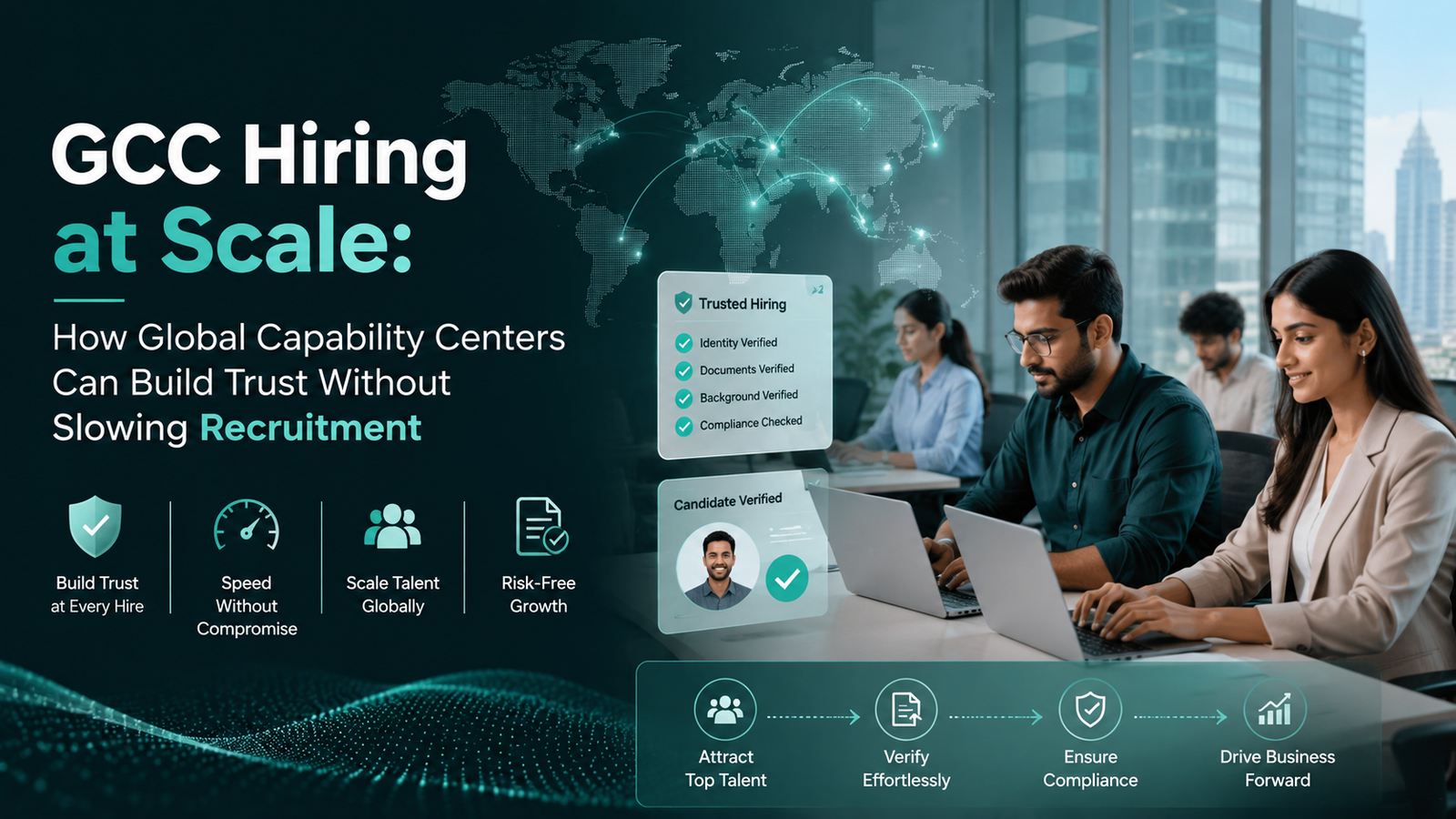
GCC Hiring at Scale: How Global Capability Centers Can Build Trust Without Slowing Recruitment
India’s Global Capability Centers (GCCs) are no longer limited to back-office operations.
They are increasingly becoming strategic hubs for technology, engineering, finance, analytics, cybersecurity, research, product development, and global business operations.
With this transformation comes a major hiring challenge:
"How do GCCs hire thousands of professionals quickly while maintaining the level of verification, compliance, and workforce trust expected by global organizations?"
Hiring at scale creates a unique problem. The more candidates an organization processes, the greater the pressure on HR teams to reduce turnaround time, automate workflows, and accelerate onboarding.
But speed without adequate verification can introduce significant workforce risk.
The answer isn't to slow hiring down.
It's to build a verification infrastructure that can scale with hiring.
The GCC Hiring Challenge Is Changing
Traditional recruitment processes were often designed for relatively predictable hiring volumes.
A company might hire:
- 50 employees
- 100 employees
- 500 employees
over a given period.
GCC hiring can look very different.
A new GCC may need to rapidly build teams across multiple functions and locations.
A single hiring program could involve:
- Software engineers
- Data scientists
- Cybersecurity professionals
- Finance teams
- Operations employees
- Managers
- Contractors
- Consultants
- Project-based workers
Each role can carry a different level of organizational risk.
This means a GCC cannot simply ask:
"How quickly can we complete BGV?"
It needs to ask:
"How can we build a verification process capable of handling different roles, volumes, locations, and risk levels simultaneously?"
Why Trust Becomes More Important at GCCs
GCC employees may work on highly sensitive global operations.
Depending on the organization, employees can have access to:
- Proprietary technology
- Source code
- Customer information
- Financial data
- Intellectual property
- Internal systems
- Research and development
- Cybersecurity infrastructure
- Confidential business information
This changes the importance of pre-employment verification.
A discrepancy in a low-risk administrative role and a discrepancy involving a highly privileged technology role should not necessarily receive the same treatment.
The risk associated with the role should influence the verification approach.
The Scale Problem: More Candidates, More Complexity
Imagine a GCC onboarding 5,000 employees over a year.
If each candidate requires multiple checks, the verification workload can quickly become significant.
For example:
5,000 candidates ×4 verification checks =20,000 individual verification activities
Now add:
- Multiple locations
- Different employers
- Different educational institutions
- Contractors
- International candidates
- Document variations
- Candidate queries
- Verification exceptions
The complexity grows rapidly.
A process that works for 100 candidates may become inefficient at 5,000.
This is why GCC BGV needs to be designed for scale from the beginning.
The Biggest Risk: Manual Verification Bottlenecks
Manual processes often involve:
Candidate submits documents
↓
HR reviews information
↓
Verification request is initiated
↓
Emails are sent
↓
External source responds
↓
HR follows up
↓
Documents are reviewed
↓
Discrepancies are investigated
↓
Report is prepared
This can work at smaller volumes.
At enterprise scale, however, manual dependency can create:
- Delayed onboarding
- Higher administrative workload
- Inconsistent processes
- Difficulty tracking cases
- Increased chances of human error
- Poor visibility for HR teams
The objective should therefore be to reduce unnecessary manual intervention—not eliminate human judgment altogether.
Automation Is the Foundation of Scalable BGV
For large GCC hiring programs, technology can help automate repetitive parts of the verification workflow.
This can include:
- Candidate onboarding
- Document collection
- Verification initiation
- Candidate reminders
- Workflow routing
- Status tracking
- Data matching
- Report generation
- Exception identification
- Dashboard reporting
Instead of HR teams manually tracking thousands of cases, technology can provide a centralized view.
For example:
| Verification Status | Candidates |
|---|---|
| Completed | 3,850 |
| In Progress | 620 |
| Awaiting Candidate | 310 |
| Exception Review | 145 |
| Pending Source Response | 75 |
This gives HR and compliance teams visibility without requiring them to manually inspect every case.
But Automation Alone Isn't Enough
There is an important distinction between automating verification and automating decisions.
A system may identify:
Name mismatch
Employment-date discrepancy
Document inconsistency
Address difference
But a discrepancy does not automatically mean fraud.
For example, an employee may have:
- Changed their address
- Changed their surname
- Used a shortened name professionally
- Experienced a difference between payroll and joining dates
- Worked under a different internal job title
Therefore, scalable BGV needs an exception-management layer.
The ideal workflow is:
Automate → Identify → Prioritize → Review → Resolve
rather than:
Automate → Reject
Risk-Based Verification: The GCC Advantage
One of the most effective ways to scale verification is to stop treating every employee exactly the same.
Consider three hypothetical GCC roles.
Role 1: Administrative Executive
Limited access to sensitive systems.
Verification: Standard checks.
Role 2: Finance Manager
Access to financial information and decision-making authority.
Verification: Enhanced verification.
Role 3: Cybersecurity Administrator
Privileged access to critical systems.
Verification: Higher-risk screening and stronger identity assurance.
The verification framework can therefore be based on:
Role + Access + Seniority + Data Sensitivity + Business Risk
This allows GCCs to allocate verification resources where they matter most.
GCCs Also Have a Contingent Workforce Challenge
Enterprise hiring doesn't always mean permanent employees.
GCCs may also work with:
- Contractors
- Consultants
- Temporary employees
- Project professionals
- Outsourced workforce
These individuals can still interact with organizational systems, facilities, data, and customers.
That creates an important question:
"Should workforce verification depend entirely on employment type?"
The better approach is to consider risk and access.
A contractor with privileged access to sensitive systems may present greater operational exposure than a permanent employee in a low-risk role.
Verification requirements should therefore be aligned with the actual risk profile of the engagement.
Global Standards, Local Verification
GCCs often operate as part of multinational organizations.
This creates another layer of complexity.
The parent organization may have global requirements around:
- Identity
- Employment history
- Education
- Criminal records
- Data handling
- Privacy
- Documentation
- Auditability
At the same time, verification must be conducted appropriately within the local regulatory and operational environment.
This means GCCs need a framework that balances:
Global consistency
with
Local requirements
The objective is not necessarily to create completely different processes for every location.
It is to establish a standardized global framework with appropriate local adaptations.
Data Privacy Cannot Be an Afterthought
Large-scale BGV involves sensitive personal information.
Depending on the verification process, organizations may handle:
- Identity information
- Contact information
- Employment history
- Educational records
- Address information
- Identification documents
- Verification results
GCCs therefore need clear controls around:
- Purpose of data collection
- Candidate transparency
- Appropriate access
- Secure storage
- Data retention
- Third-party processing
- Data sharing
- Audit trails
The bigger the hiring operation, the more important data governance becomes.
Scale increases both efficiency opportunities and data responsibility.
Candidate Experience Matters at Enterprise Scale
BGV is not only a compliance activity.
It is also part of the candidate experience.
Imagine two candidates:
Candidate A
Receives a clear verification request, uploads documents once, receives status updates, and can easily respond to queries.
Candidate B
Receives multiple emails, repeatedly submits the same documents, has no visibility into status, and doesn't know why additional information is required.
Both candidates may eventually complete verification.
But their perception of the employer can be very different.
For GCCs competing for specialized talent, candidate experience can influence:
- Offer acceptance
- Joining rates
- Employer reputation
- Candidate satisfaction
Therefore:
"A scalable BGV process should be candidate-friendly, not just HR-friendly."
The Importance of Real-Time Visibility
At enterprise scale, HR teams need more than a final BGV report.
They need visibility throughout the process.
A centralized dashboard can help answer:
- How many candidates are being verified?
- Which checks are completed?
- Which cases are delayed?
- Where are discrepancies occurring?
- Which candidates are awaiting action?
- Which cases require HR intervention?
- Which verification sources have longer turnaround times?
This changes BGV from a reactive activity into a measurable operational process.
Measuring BGV Performance at GCC Scale
GCCs should look beyond a single metric such as turnaround time.
A stronger measurement framework can include:
Turnaround Time
How quickly is verification completed?
Completion Rate
What percentage of initiated checks are completed?
Exception Rate
How many cases require additional review?
Resolution Time
How quickly are discrepancies resolved?
Candidate Drop-Off
How many candidates abandon the process?
Accuracy
How reliable are verification outcomes?
Automation Rate
How much of the workflow is processed without unnecessary manual intervention?
Compliance
Can verification activities be properly tracked and audited?
These metrics help GCC leadership understand whether the BGV process is actually scalable.
Building a Scalable GCC BGV Framework
A mature enterprise verification model can be built around six layers.
Layer 1: Candidate Identity
Establish that the candidate is who they claim to be.
Layer 2: Credential Verification
Validate relevant educational and professional qualifications.
Layer 3: Employment Verification
Confirm previous employment and relevant experience.
Layer 4: Risk-Based Screening
Apply appropriate checks based on role and organizational exposure.
Layer 5: Exception Management
Investigate discrepancies rather than treating every mismatch as automatic fraud.
Layer 6: Governance & Reporting
Maintain visibility, auditability, data controls, and management reporting.
Together, these layers create a framework that can scale without making verification unnecessarily complicated.
What a Future-Ready GCC Hiring Workflow Could Look Like?
Instead of:
Candidate Selected
↓
Manual Documents
↓
Email-Based Verification
↓
Multiple Follow-Ups
↓
Delayed Onboarding
A technology-enabled workflow could look like:
Candidate Selected
↓
Digital Verification Initiation
↓
Automated Document Collection
↓
Identity & Credential Checks
↓
Employment & Relevant Risk Checks
↓
Automated Status Tracking
↓
Exception-Based Human Review
↓
Final Verification Report
↓
Onboarding
This approach allows HR teams to focus their time on cases that actually need human attention.
Five Questions GCC HR Leaders Should Ask
Before scaling a hiring program, HR and talent leaders should ask:
1. Can our current BGV process handle 5x the hiring volume?
A process should be tested for future scale, not just current workload.
2. How much of our process is still manual?
Manual intervention should be reserved for situations where judgment is genuinely required.
3. Are all roles being screened identically?
If so, the organization may be over-verifying some roles and under-verifying others.
4. Can we see the status of every verification in one place?
Enterprise hiring requires visibility.
5. Can we demonstrate how a verification decision was reached?
A scalable process should also be an auditable process.
The Future of GCC Hiring Is Built on Workforce Trust
India's GCC ecosystem is becoming increasingly sophisticated.
The focus is shifting from simply creating large teams to building high-value, globally integrated capabilities.
That means the workforce itself becomes a strategic asset.
And strategic workforces require trust.
The goal isn't to make every hiring process longer.
It is to make verification:
- Faster
- Smarter
- Risk-based
- Transparent
- Scalable
- Auditable
Technology can remove repetitive administrative work.
Risk-based workflows can focus attention where it matters.
Automation can improve turnaround time.
Human review can provide context when data doesn't tell the whole story.
Together, these capabilities allow organizations to scale hiring without scaling risk at the same rate.
Final Takeaway
For GCCs, hiring at scale is not simply a recruitment challenge.
It is an operational, compliance, technology, and workforce-risk challenge.
When thousands of employees, contractors, and professionals are being onboarded across different functions and locations, traditional manual BGV processes can quickly become bottlenecks.
But the solution isn't to choose between:
Speed OR verification.
The future is:
"Speed THROUGH better verification infrastructure".
A scalable GCC hiring strategy should combine automation, risk-based screening, reliable verification, candidate-friendly workflows, data governance, exception management, and real-time visibility.
Because the objective isn't simply to onboard more people.
It is to build a trusted workforce at enterprise scale without slowing the business down.