Legal Do’s and Don’ts of Employee Background Verification in India
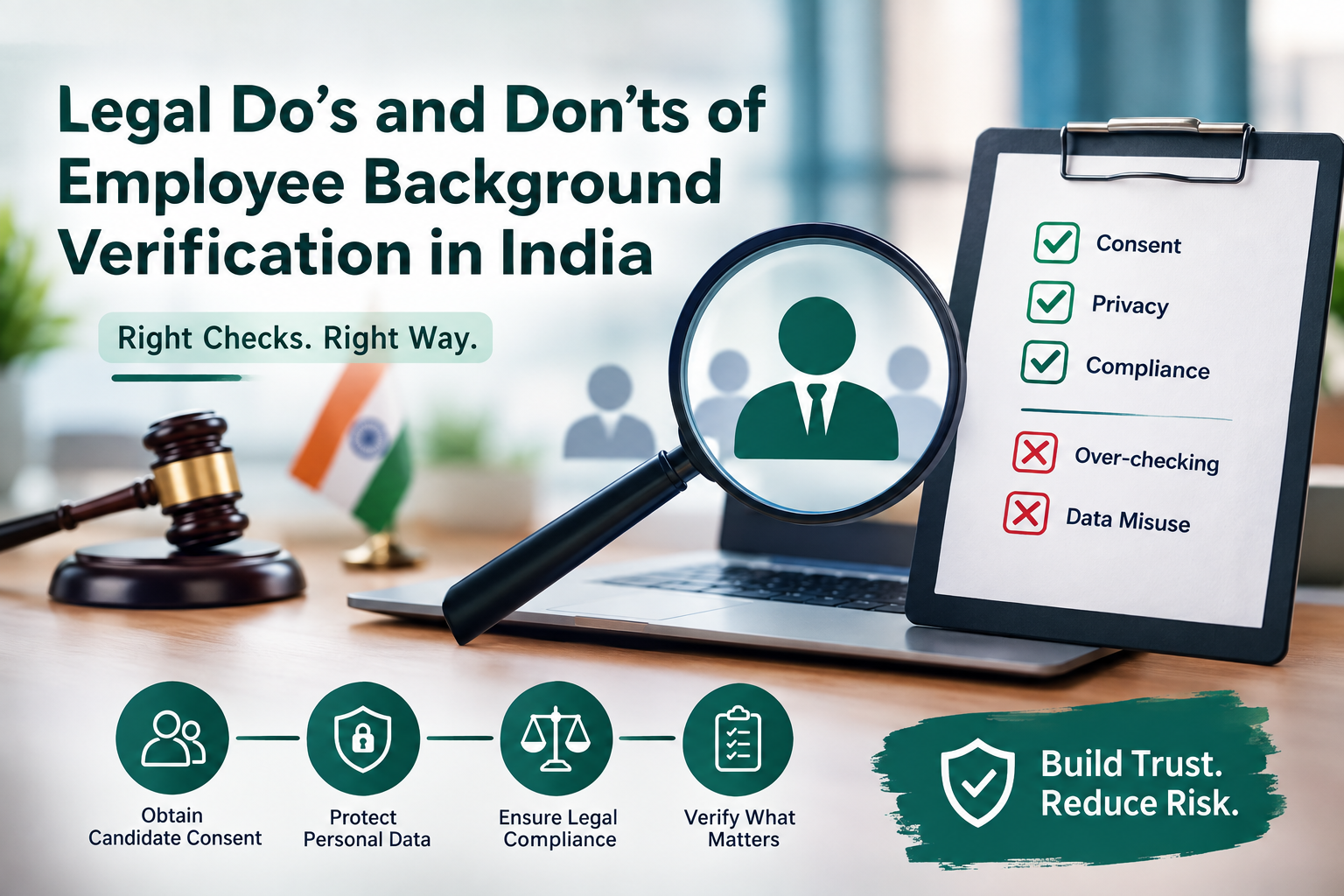
"Employee Background Verification is essential for building a trustworthy workforce, but it must be conducted within appropriate privacy and data-protection boundaries. This guide explores the key legal Do’s and Don’ts of employee BGV in India, covering candidate consent, purpose limitation, data security, third-party BGV providers, sensitive information, criminal checks, data retention, and the evolving Digital Personal Data Protection framework. "
Legal Do’s and Don’ts of Employee Background Verification in India
Employee Background Verification (BGV) has become an important part of modern hiring. Organizations use verification to validate a candidate’s identity, education, employment history, address, professional credentials, and, where appropriate, criminal or financial information.
But background verification is not simply an HR checklist.
It involves collecting, processing, sharing, and storing personal information. That means employers and Background Verification providers need to consider privacy, data protection, consent, security, proportionality, and applicable employment or sector-specific requirements.
India currently does not have one single law dedicated exclusively to employee background verification. Instead, organizations need to navigate a combination of privacy and data-protection requirements, employment principles, contractual obligations, sector-specific requirements, and the evolving framework under the Digital Personal Data Protection Act, 2023 (DPDP Act).
With the Digital Personal Data Protection Rules, 2025 now notified, organizations should also prepare their BGV processes for the new data-protection framework and its phased implementation.
So, what should employers do and what should they avoid?
Understanding the Legal Landscape of Background Verification in India
The first thing organizations should understand is that background verification is not prohibited in India.
Employers have legitimate reasons for verifying candidate information. Depending on the role, verification can help organizations:
-
Validate qualifications and experience
-
Reduce hiring fraud
-
Protect confidential information
-
Manage workforce-related risks
-
Meet contractual or regulatory requirements
-
Protect customers and business assets
-
Ensure that candidates have accurately represented material information
However, the process must be conducted responsibly.
India's privacy jurisprudence recognizes privacy as a fundamental right under Article 21 of the Constitution. The Supreme Court's landmark privacy judgment also emphasized principles including legality, legitimate purpose, and proportionality when privacy is restricted.
For employers, this means that the objective of a background check should be connected to a legitimate employment-related purpose, and the information collected should be handled responsibly.
The Do’s of Employee Background Verification
1. DO Inform Candidates About the Verification
Transparency should be the starting point of the BGV process.
Candidates should know that background verification will be conducted and should receive meaningful information about the scope and purpose of the verification.
For example, an organization may explain that checks could cover:
-
Identity
-
Address
-
Employment history
-
Educational qualifications
-
Professional credentials
-
Criminal records, where relevant
-
Other role-specific information
A clear BGV policy helps candidates understand what information is being requested and why.
Under the notified DPDP framework, notice requirements are designed around clear, standalone, understandable communication about the personal data being collected and the purpose for processing.
2. DO Obtain Appropriate Consent
Consent is an important part of privacy-compliant BGV practices, particularly where personal or sensitive information is involved under the existing framework.
Organizations should avoid relying on vague statements such as:
“The company may conduct verification whenever required.”
A stronger approach is to clearly identify the nature and purpose of the checks.
Where consent is the basis for processing under the DPDP Act, the Act provides that consent must be free, specific, informed, and unambiguous, and it provides a mechanism for withdrawal.
Organizations should therefore build their BGV consent process around:
-
Clear language
-
Specific purposes
-
Appropriate scope
-
Transparent disclosures
-
Proper records of consent
-
A defined process for withdrawal where applicable
Because the DPDP Act's core processing provisions are being brought into force in phases, organizations should distinguish between requirements that are already legally operative and requirements they are preparing to comply with.
3. DO Follow the Principle of Purpose Limitation
Information collected for BGV should have a defined purpose.
For example, if an organization collects employment information to verify a candidate's previous experience, that information should not automatically become a source for unrelated activities.
Organizations should ask:
Why are we collecting this information?
Is it relevant to the verification?
Do we actually need it?
The notified DPDP Rules emphasize clear communication of the purpose for which personal data is being collected and processed.
Purpose limitation is therefore not just a legal consideration—it is also a good governance practice.
4. DO Collect Only Relevant Information
More data does not automatically mean better verification.
A BGV process should be proportionate to the role and the risk involved.
For example, the verification requirements for:
-
A junior administrative role
-
A finance executive
-
A cybersecurity administrator
-
A senior executive
may reasonably differ.
Organizations should consider:
-
Role responsibilities
-
Level of system access
-
Access to sensitive information
-
Financial authority
-
Regulatory exposure
-
Seniority
-
Nature of employment
The objective should be to collect relevant information required for legitimate verification, rather than collecting everything available.
5. DO Protect Candidate Information
BGV generates highly valuable personal information.
Organizations may receive:
-
Identity documents
-
Address information
-
Employment records
-
Educational documents
-
Financial information in certain checks
-
Criminal-record-related information
-
Biometric information in some verification workflows
This information should not be treated like ordinary recruitment data.
Organizations should implement appropriate technical and organizational safeguards to reduce the risk of:
-
Unauthorized access
-
Accidental disclosure
-
Data theft
-
Misuse
-
Unauthorized modification
-
Data breaches
The existing IT Act framework includes obligations relating to reasonable security practices for sensitive personal data, while the DPDP framework introduces broader data-protection obligations as its provisions come into force.
6. DO Carefully Manage Third-Party BGV Providers
Many organizations outsource background verification to specialist providers.
That does not mean the employer can simply transfer responsibility and forget about data governance.
Before engaging a BGV provider, organizations should evaluate:
-
Data security practices
-
Access controls
-
Data-processing arrangements
-
Confidentiality obligations
-
Data retention practices
-
Sub-processing arrangements
-
Breach-management procedures
-
Audit and compliance capabilities
Under the DPDP framework, organizations using data processors remain responsible for ensuring appropriate compliance in relation to processing carried out on their behalf.
A BGV vendor should therefore be treated as an important part of the organization's data-processing ecosystem.
7. DO Maintain an Audit Trail
A well-designed BGV process should be traceable.
Organizations should maintain appropriate records showing:
-
What verification was requested
-
Why it was requested
-
Candidate authorization or consent, where applicable
-
What information was collected
-
Which verification provider processed it
-
Verification results
-
Exceptions or discrepancies identified
-
How discrepancies were resolved
-
Relevant communications
-
Data retention or deletion actions
A documented process can help organizations demonstrate that their verification activities were structured and consistent.
8. DO Give Candidates an Opportunity to Explain Material Discrepancies
A verification discrepancy does not automatically mean fraud.
For example, a discrepancy could result from:
-
Different name formats
-
Incorrect dates
-
Employer database errors
-
University record issues
-
Address changes
-
Delayed record updates
-
Administrative mistakes
Therefore, organizations should distinguish between:
Discrepancy
and
Proven Misrepresentation
Where appropriate, candidates should be given an opportunity to provide clarification or supporting documentation before a serious adverse decision is made.
This creates a fairer and more defensible process.
9. DO Define Data Retention Practices
Keeping candidate information indefinitely creates unnecessary privacy and security exposure.
Organizations should establish a clear retention approach based on:
-
Purpose of processing
-
Legal requirements
-
Contractual requirements
-
Regulatory obligations
-
Internal policies
-
Dispute or litigation requirements
Once information is no longer required and there is no legal reason to retain it, organizations should consider appropriate deletion or anonymization practices.
The existing SPDI framework also contains principles relating to retention and requires information to be retained only for as long as necessary for the lawful purpose or as otherwise required by law.
The Don’ts of Employee Background Verification
1. DON'T Conduct Unnecessary Checks
One of the biggest mistakes organizations make is assuming that a more extensive BGV is always better.
It isn't.
Running every possible check on every candidate can:
-
Increase costs
-
Delay hiring
-
Create unnecessary data exposure
-
Increase candidate friction
-
Make the process difficult to manage
Verification should be risk-based and role-relevant.
2. DON'T Collect Sensitive Information Without Proper Controls
Certain categories of information require heightened care.
Under the existing SPDI Rules, sensitive personal data includes categories such as passwords, financial information, physical, physiological and mental health information, medical records and history, sexual orientation, and biometric information, subject to the Rules' definitions and exceptions.
Organizations should therefore avoid casually requesting or storing sensitive information simply because it is technically available.
Ask:
Do we need this information?
Is there a legitimate purpose?
Do we have appropriate safeguards?
3. DON'T Hide the BGV Process From Candidates
A candidate should not be surprised to discover that an employer has collected information about them from multiple sources.
Transparency builds trust.
Organizations should clearly communicate:
-
That verification will take place
-
What categories of information may be checked
-
Why the information is required
-
Whether a third-party provider is involved
-
How candidates can raise questions or concerns
The notified DPDP Rules specifically emphasize clear and understandable notices regarding data collection and purpose.
4. DON'T Treat Public Information as a Free Pass
The fact that information is publicly accessible does not automatically mean organizations should collect, combine, store, and use it without considering purpose and proportionality.
Organizations should distinguish between:
“This information can be found online.”
and
“We have a legitimate reason to collect and use this information for this verification.”
This distinction becomes increasingly important as organizations use social media, databases, search tools, and automated technologies during recruitment.
5. DON'T Make Decisions Solely on Unverified Data
Automated tools can identify potential discrepancies, but a flag is not necessarily proof of wrongdoing.
For example:
Name match ≠ confirmed identity
Record match ≠ confirmed candidate
Database result ≠ final conclusion
Organizations should use appropriate human review, particularly when a verification result could materially affect a candidate's employment opportunity.
6. DON'T Ignore Data Security After the Verification Is Complete
BGV data remains sensitive even after the hiring decision has been made.
Organizations should avoid:
-
Keeping unnecessary copies
-
Sharing reports through unsecured channels
-
Allowing unrestricted internal access
-
Storing documents indefinitely
-
Sending candidate data to unauthorized recipients
Security must cover the entire data lifecycle, from collection to deletion.
7. DON'T Use BGV Data for Unrelated Purposes
If information was collected for employment verification, it should not automatically be repurposed for unrelated activities.
For example, BGV information should not casually become a source for:
-
Marketing
-
Unrelated profiling
-
Commercial targeting
-
Unconnected employee analytics
Any additional processing should have an appropriate legal basis and should be consistent with applicable data-protection requirements.
What About Criminal Background Checks?
Criminal-record verification is one of the most sensitive areas of BGV.
Organizations should consider whether such a check is genuinely relevant to the role and whether the information being relied upon is accurate and appropriately sourced.
A criminal-record-related flag should not automatically be treated as proof of misconduct.
Organizations should consider:
-
The nature of the role
-
The relevance of the information
-
The reliability of the source
-
The accuracy of the record
-
Whether the information actually relates to the candidate
-
Applicable legal requirements
The process should be carefully documented and handled with appropriate confidentiality.
What About Employment and Education Verification?
Employment and education verification are among the most common BGV checks.
Organizations may verify:
-
Employer name
-
Job title
-
Employment dates
-
Compensation, where legitimately required
-
Educational institution
-
Qualification
-
Graduation year
-
Professional certifications
However, the information requested should remain relevant to the purpose of the verification.
A verification provider should also avoid making assumptions when records do not match exactly.
For example, a difference between “Senior Software Engineer” and “Software Engineer” may require clarification rather than automatically being categorized as fraud.
Why Consent Should Not Be a Checkbox Exercise
One of the biggest weaknesses in BGV processes is treating consent as a formality.
A candidate may technically sign a document without understanding:
-
What information will be collected
-
Who will receive it
-
Why it is being collected
-
How long it may be retained
-
What checks will be conducted
A better approach is to make consent part of a transparent candidate experience.
The DPDP Act's consent framework provides for consent that is free, specific, informed and unambiguous, and provides for withdrawal where consent is the basis of processing.
Organizations should therefore build BGV authorization around clarity rather than legal jargon.
How Organizations Can Build a Legally Responsible BGV Process
A practical framework can look like this:
Step 1: Define the Purpose
Determine why verification is required.
Step 2: Assess Role Risk
Evaluate responsibilities, access, seniority, and regulatory exposure.
Step 3: Define the Scope
Identify which checks are actually relevant.
Step 4: Inform the Candidate
Clearly explain the verification process.
Step 5: Obtain Appropriate Authorization
Capture consent or rely on another applicable legal basis where appropriate.
Step 6: Conduct Verification
Use reliable and authorized sources and verification methods.
Step 7: Review Discrepancies
Do not automatically treat every mismatch as fraud.
Step 8: Secure the Information
Restrict access and implement appropriate security controls.
Step 9: Document Decisions
Maintain an appropriate audit trail.
Step 10: Retain and Delete Responsibly
Keep information only for as long as necessary or legally required.
The Future of BGV Compliance in India
The regulatory environment around personal data in India is changing significantly.
The Digital Personal Data Protection Act was enacted in 2023, and the Digital Personal Data Protection Rules were notified in November 2025. The government has established a phased implementation timeline, with different provisions taking effect at different stages.
As the new framework becomes operational, organizations will need to pay greater attention to:
-
Transparent notices
-
Purpose-specific processing
-
Consent management
-
Data security
-
Individual rights
-
Processor governance
-
Data retention
-
Breach response
-
Accountability
For HR teams, this means BGV should no longer be treated as an isolated recruitment activity.
It should become part of the organization's broader privacy, compliance, and workforce-risk framework.
Final Takeaway
Employee Background Verification is an important tool for building a trustworthy workforce, but verification must be balanced with privacy and responsible data handling.
The best BGV strategy is not simply about conducting more checks.
It is about conducting the right checks, for the right role, with the right purpose, using the right safeguards.
Organizations should:
Inform candidates.
Obtain appropriate authorization.
Collect relevant information.
Protect personal data.
Work carefully with BGV providers.
Review discrepancies fairly.
Maintain appropriate records.
Retain information responsibly.
And most importantly:
Background verification should reduce organizational risk without creating unnecessary privacy risk for candidates.
As India's data-protection framework evolves, organizations that build transparent, proportionate, secure, and well-documented BGV processes will be better positioned to manage both hiring risk and compliance expectations.
Disclaimer: This article is intended for general informational purposes and should not be treated as legal advice. Organizations should obtain advice specific to their facts, industry, jurisdiction, and applicable laws before designing or changing their background verification processes.