The BGV Data Problem: What Happens When Background Verification Data Is Wrong?
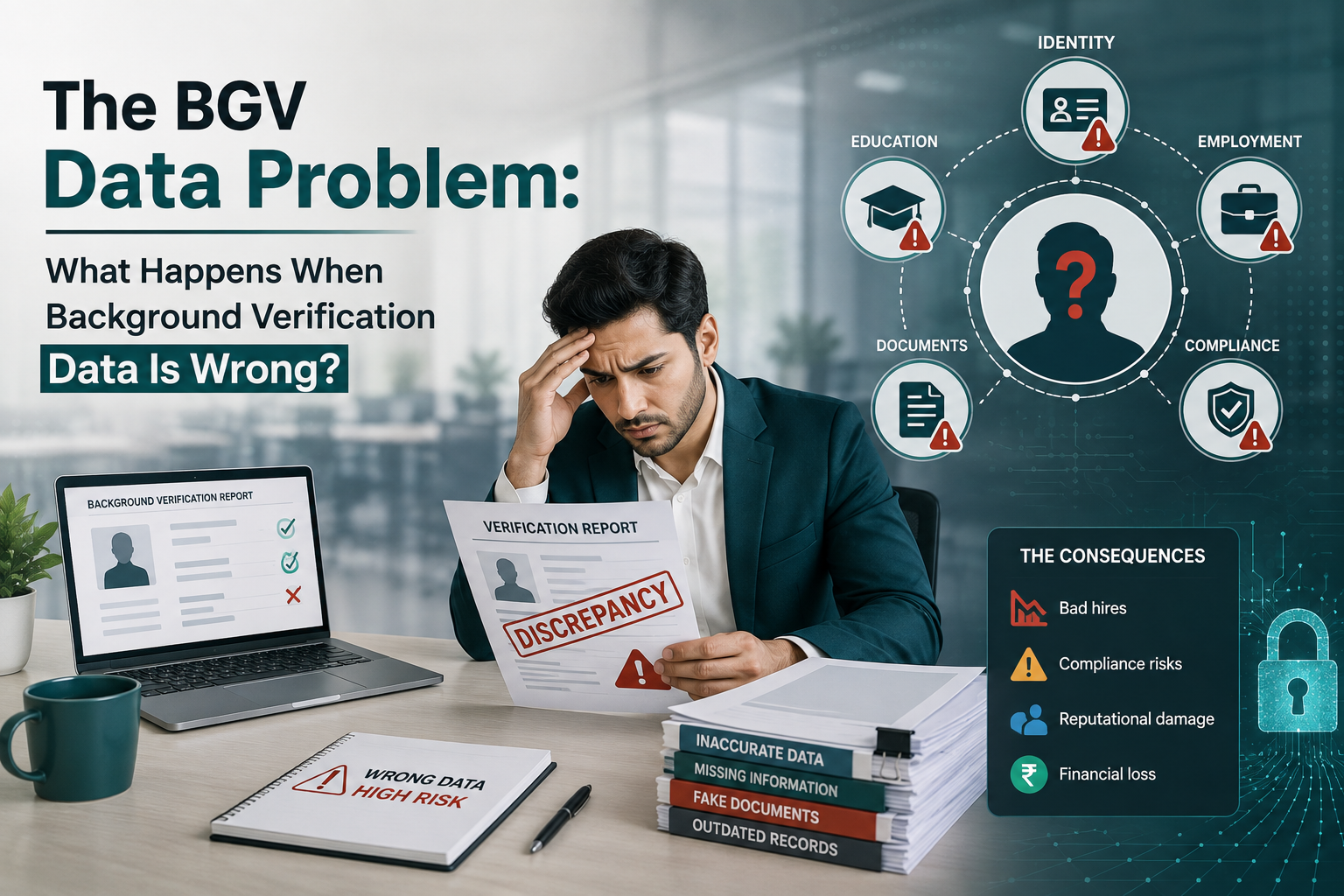
"Background verification is only as reliable as the data behind it. Incorrect records, name mismatches, outdated information, employment discrepancies, and automated false positives can result in legitimate candidates being wrongly flagged. This article explores the BGV data problem, why accuracy matters, and how organizations can combine reliable data sources, technology, risk-based workflows, and human review to make more trustworthy hiring decisions."
The BGV Data Problem: What Happens When Background Verification Data Is Wrong?
Background verification is designed to answer a simple question:
Can an organization trust the information provided by a candidate?
But there is another question that is often overlooked:
Can the organization trust the information being used to verify that candidate?
Background Verification (BGV) is increasingly becoming a technology-driven process. Organizations use databases, digital records, third-party sources, automated workflows, document verification, identity matching, and other data points to assess candidates.
These systems can significantly improve the speed and scale of hiring.
But technology does not automatically guarantee accuracy.
A database may contain an outdated record. A name may be incorrectly matched. An employment date may differ across records. An address may have changed. A candidate may share a name with another individual.
The result?
A perfectly legitimate candidate could be flagged because the verification data is incomplete, outdated, inconsistent, or incorrectly interpreted.
This is the BGV data problem.
And it raises an important question for HR leaders:
What happens when the process designed to identify risk becomes a source of risk itself?
What Is the BGV Data Problem?
The BGV data problem occurs when inaccurate, incomplete, outdated, mismatched, or poorly interpreted information influences a background verification outcome.
It can happen at multiple stages of the verification process.
For example:
Candidate provides information
↓
Data is collected
↓
Information is matched against external sources
↓
A discrepancy is detected
↓
The discrepancy is interpreted
↓
A BGV result is generated
The problem may not always be with the candidate.
It could originate anywhere in the chain.
A single inaccurate data point can potentially create an incorrect conclusion.
Why Data Accuracy Matters in Background Verification
The purpose of BGV is to reduce hiring risk.
But inaccurate verification can create a different kind of risk.
For employers, inaccurate results can lead to:
-
Delayed hiring
-
Candidate rejection
-
Additional administrative work
-
Increased verification costs
-
Poor candidate experience
-
Compliance concerns
-
Reputation damage
For candidates, the consequences can be even more significant.
A false discrepancy could affect:
-
Job opportunities
-
Employment decisions
-
Professional reputation
-
Career progression
-
Trust in the employer
This is why accuracy should be treated as a core BGV metric—not simply an operational detail.
Not Every Mismatch Is Fraud
This is perhaps the most important principle in modern background verification.
A mismatch is a signal. It is not automatically proof of fraud.
Consider a candidate whose employment record shows:
January 2022 – December 2023
while the candidate's resume states:
February 2022 – December 2023
Is that fraud?
Not necessarily.
It could be:
-
A data-entry error
-
A difference between joining date and official employment date
-
An HR database issue
-
A misunderstanding by the candidate
-
A legitimate discrepancy
Similarly, a candidate's name may appear differently across documents.
For example:
Rahul Kumar
Rahul K. Kumar
Rahul Kumar Sharma
A name variation does not automatically indicate identity fraud.
The context matters.
Common Sources of Incorrect BGV Data
1. Name Mismatches
Names can vary because of:
-
Middle names
-
Initials
-
Spelling variations
-
Marriage-related changes
-
Regional naming conventions
-
Transliteration between languages
-
Typographical errors
This becomes particularly important when automated systems rely heavily on exact or near-exact matching.
A system may identify multiple records that appear similar.
The challenge is determining:
Which record actually belongs to the candidate?
2. Address Changes
People move.
A candidate may have:
-
Current address
-
Permanent address
-
Previous address
-
Employer-provided accommodation
-
Temporary accommodation
-
Different addresses across official documents
Therefore, an address mismatch is not necessarily suspicious.
A good verification process should distinguish between:
Different address
and
Unexplained or materially inconsistent address information.
3. Employment Date Differences
Employment records can contain differences in:
-
Joining date
-
Last working day
-
Notice period
-
Payroll period
-
Contract period
-
Internship duration
For example, a candidate may list their employment period based on their joining and resignation dates, while an employer database reflects payroll dates.
The difference may be legitimate.
Automatically categorizing it as misrepresentation can create a false positive.
4. Job Title Differences
Job titles can vary significantly between organizations.
One employer might use:
Software Engineer
while another uses:
Software Developer
A candidate may describe their role using an industry-standard title rather than the exact internal designation.
This doesn't necessarily mean the candidate fabricated their experience.
The important question is:
Did the candidate actually perform the claimed responsibilities?
5. Educational Record Differences
Education verification can also produce discrepancies.
Potential differences may involve:
-
Name formatting
-
Graduation year
-
Course title
-
Institution name
-
Affiliated university
-
Distance-learning designation
-
Degree completion date
Institutions may also maintain records in different formats.
This is why education verification should rely on appropriate institutional or authoritative sources wherever possible.
6. Outdated Databases
One of the biggest challenges in verification is data freshness.
A database may contain information that was accurate at one point but is no longer current.
For example:
-
Previous address
-
Old employer information
-
Historical records
-
Outdated contact details
-
Old professional designation
If organizations treat every database entry as current and definitive, they may reach incorrect conclusions.
Data availability does not always equal data accuracy.
7. Human Data-Entry Errors
Not every problem is caused by technology.
Humans enter enormous amounts of information into systems.
Errors can occur when:
-
Names are entered incorrectly
-
Dates are transposed
-
Documents are scanned incorrectly
-
Information is manually copied
-
Records are updated inconsistently
A single typo can potentially trigger an automated discrepancy.
8. Duplicate or Similar Identities
Common names create another challenge.
Imagine a candidate named:
Amit Kumar
There could be numerous people with the same name.
If the verification process matches a record using only:
Name + approximate location
the possibility of incorrect attribution increases.
Identity matching should therefore consider multiple relevant data points rather than relying on one identifier.
The False Positive Problem
A false positive occurs when a verification process flags a candidate as potentially problematic even though the underlying concern does not actually apply to them.
For example:
System finds matching criminal-record information
↓
Candidate name is similar
↓
Record is flagged
But further investigation shows that:
The record belongs to another person with a similar name.
This is why automated matching should not always be treated as a final decision.
The system should help identify cases requiring review.
Automation Can Reduce Errors But It Can Also Scale Them
Automation is one of the biggest opportunities in modern BGV.
Automated systems can help with:
-
Data collection
-
Document processing
-
Record matching
-
Workflow management
-
Status tracking
-
Report generation
-
Anomaly detection
But automation introduces an important principle:
If the input data is wrong, automation can make the wrong result faster.
Imagine a system processing 10,000 candidates.
If a matching rule is poorly designed, the issue may not affect one candidate.
It could affect hundreds.
This is why automation needs:
-
Quality controls
-
Validation
-
Exception handling
-
Human review
-
Regular testing
-
Clear escalation rules
The objective isn't simply to automate.
It is to automate responsibly.
AI and the Accuracy Challenge
Artificial intelligence can make BGV more sophisticated.
AI can potentially identify patterns that traditional rule-based systems may miss.
For example, AI-assisted systems may help detect:
-
Unusual data combinations
-
Document anomalies
-
Inconsistent timelines
-
Duplicate identities
-
Suspicious patterns
-
Unusual verification behavior
But AI also has limitations.
An AI model can misinterpret data.
It may generate a false signal.
It may overemphasize certain patterns.
And if the underlying data is incomplete, its conclusion may be unreliable.
Therefore:
AI should support verification not replace verification judgment.
Why Human Review Still Matters
Suppose an automated system identifies a discrepancy.
The next step should not automatically be:
Reject candidate.
Instead:
Flag → Investigate → Validate → Clarify → Decide
Human review can consider context that automated systems may not fully understand.
For example:
-
Is the name variation legitimate?
-
Is the employment discrepancy material?
-
Could the record belong to someone else?
-
Is the database outdated?
-
Does the candidate have supporting documentation?
-
Can the information be independently confirmed?
This approach creates a more balanced verification process.
Candidate Experience Is Also at Risk
BGV isn't only about organizations.
There is a person on the other side of every verification case.
Imagine a candidate receives an email saying:
“Your background verification has identified a discrepancy.”
But the discrepancy is actually caused by:
-
A spelling error
-
An outdated record
-
A database mismatch
-
A similar name
-
An employer's incorrect record
The candidate may feel unfairly judged.
Repeated requests for documents can also create frustration.
This can negatively affect:
-
Candidate trust
-
Employer brand
-
Offer acceptance
-
Candidate experience
Therefore, accuracy and communication need to work together.
The Importance of Explainable Verification
A modern BGV system should ideally be able to answer:
What was checked?
What source was used?
What information was matched?
What caused the discrepancy?
How confident is the result?
Was the discrepancy reviewed?
What evidence supports the final conclusion?
This creates greater transparency for HR and compliance teams.
It also makes the process easier to audit and improve.
Data Quality Should Be Measured
Organizations often measure BGV performance using:
-
Turnaround time
-
Number of checks completed
-
Cost per verification
-
Cases processed
These are important.
But organizations should also consider data-quality metrics.
For example:
False Positive Rate
How often are legitimate candidates incorrectly flagged?
Exception Rate
How many cases require manual investigation?
Data Completeness
How often is required information missing?
Source Reliability
How dependable are the data sources being used?
Resolution Time
How long does it take to resolve a discrepancy?
Verification Accuracy
How frequently do verification outcomes withstand subsequent validation?
These metrics provide a much better picture of BGV effectiveness.
How Organizations Can Reduce BGV Data Errors
1. Use Multiple Relevant Identifiers
Avoid relying on a single piece of information when matching identities.
Depending on the check and applicable requirements, organizations may use combinations of:
-
Name
-
Date of birth
-
Address
-
Candidate-provided identifiers
-
Employer information
-
Educational information
The objective is to increase confidence in the match.
2. Prioritize Reliable Sources
Not all data sources carry the same level of reliability.
Where possible, organizations should prioritize:
-
Authoritative records
-
Official institutional sources
-
Verified employer information
-
Appropriate government or regulatory sources
-
Reliable verification partners
Source quality directly affects verification quality.
3. Create an Exception-Review Process
Not every discrepancy needs the same level of investigation.
Organizations can establish defined categories:
Low-risk mismatch
→ Clarify
Potentially material discrepancy
→ Investigate
High-risk or unresolved issue
→ Escalate
This prevents HR teams from treating every mismatch as equally serious.
4. Give Candidates a Clarification Opportunity
When appropriate, candidates should be allowed to explain material discrepancies.
This is particularly important where an automated result could significantly affect an employment decision.
A clarification process can help distinguish:
Error
from
Misrepresentation
from
Fraud
These are not the same thing.
5. Keep Data Updated
Organizations should understand how frequently their verification sources are refreshed.
Old data can produce new problems.
Data freshness should therefore be part of vendor and source evaluation.
6. Audit Automated Rules
Verification algorithms and matching rules should be periodically reviewed.
Organizations should ask:
-
Are too many legitimate candidates being flagged?
-
Are certain types of names producing more mismatches?
-
Are particular data sources creating recurring issues?
-
Are false positives increasing?
-
Are manual reviewers consistently overriding automated results?
The goal should be continuous improvement.
BGV Should Be Risk-Based
Not every discrepancy has the same significance.
Consider the difference between:
A one-day employment-date mismatch
and
A completely unverifiable employment history for a senior executive.
Treating both cases identically is inefficient.
Organizations should consider:
-
Role sensitivity
-
Candidate seniority
-
Access to sensitive information
-
Financial authority
-
Regulatory exposure
-
Nature of the discrepancy
-
Reliability of the source
-
Potential business impact
This creates a more proportionate verification process.
Accuracy vs. Speed: The Real BGV Equation
Organizations often focus heavily on verification turnaround time.
But there are actually three important dimensions:
-
Speed
How quickly can the verification be completed?
-
Accuracy
How reliable is the result?
-
Risk
What happens if the result is wrong?
Optimizing only for speed can create false positives and false negatives.
Optimizing only for accuracy through entirely manual processes can make verification slow and expensive.
The objective should therefore be:
Fast enough to support hiring. Accurate enough to support decisions. Robust enough to manage risk.
The Future of BGV Is Data-Centric
The next evolution of background verification will not simply be about adding more checks.
It will be about improving the quality and interpretation of the data behind those checks.
A modern BGV ecosystem will increasingly need:
- Reliable data sources
- Identity resolution
- Automated workflows
AI-assisted anomaly detection
Human review
Auditability
Strong data governance
This combination can help organizations move from basic background checking toward intelligent workforce risk management.
What HR Leaders Should Ask Their BGV Provider
Before selecting or reviewing a BGV provider, HR and compliance teams should consider asking:
-
How do you validate data sources?
-
How do you handle name variations?
-
How do you prevent false identity matches?
-
What happens when a discrepancy is detected?
-
Is there human review for high-impact cases?
-
How frequently are data sources updated?
-
How are candidate documents protected?
-
Can verification results be audited?
-
How do you measure accuracy and false positives?
-
How does your platform distinguish a discrepancy from confirmed fraud?
These questions can reveal much more than simply asking:
“How fast can you complete a background check?”
The Bigger Picture
Background verification exists because organizations cannot rely entirely on self-declared candidate information.
But organizations also cannot blindly assume that every external record is correct.
That creates a two-sided verification responsibility:
Verify the candidate.
Verify the data.
A trustworthy BGV process needs both.
When organizations focus only on finding discrepancies, they risk overlooking the possibility that the discrepancy itself may be inaccurate.
When they focus on data quality, context, source reliability, and human review, they create a much stronger foundation for hiring decisions.
Final Takeaway
The future of background verification isn't simply about collecting more data.
It is about trusting the right data, interpreting it correctly, and knowing when a mismatch actually means something.
A name variation isn't automatically fraud.
An employment-date difference isn't automatically misrepresentation.
A database match isn't automatically the right person.
And an automated flag isn't automatically a final decision.
The strongest BGV processes combine:
- Accurate data
- Reliable sources
- Intelligent technology
- Risk-based workflows
- Human judgment
- Clear candidate communication
Because the purpose of background verification isn't to find the maximum number of discrepancies.
It is to provide organizations with accurate, relevant, and actionable information they can trust when making hiring decisions.
In BGV, finding a mismatch is only the beginning. Understanding whether that mismatch actually matters is where real verification begins.
Disclaimer: This article is intended for general informational purposes and does not constitute legal advice. Organizations should assess their BGV processes against applicable privacy, employment, data-protection, and sector-specific requirements.