The New Face of Hiring Fraud: How AI Is Changing Candidate Verification in 2026
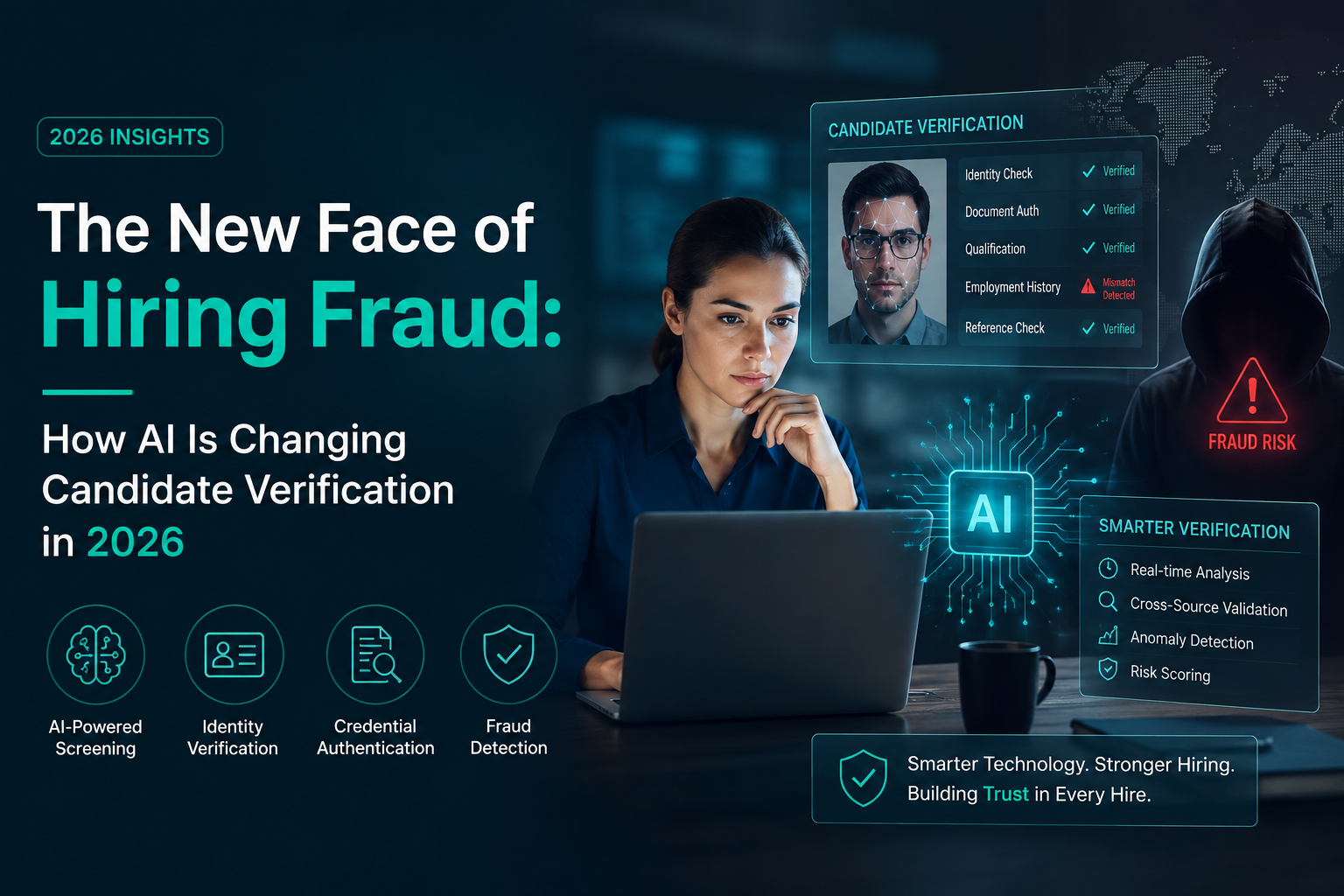
"# Short Excerpt AI is transforming hiring fraud. From AI-generated resumes and manipulated documents to synthetic identities and deepfake interviews, fraudulent candidates are becoming harder to identify through traditional screening alone. This guide explores how candidate fraud is evolving in 2026 and how organizations can build layered, AI-enabled background verification processes to strengthen identity, credential, and workforce trust. "
The New Face of Hiring Fraud: How AI Is Changing Candidate Verification in 2026
For years, hiring fraud followed a relatively familiar pattern.
A candidate might exaggerate their experience, add a qualification they never earned, alter an employment document, or provide misleading information on a resume.
Background verification was designed to catch these discrepancies.
But the hiring landscape is changing.
Artificial intelligence has made it easier to create convincing resumes, manipulate documents, generate realistic voices and faces, and potentially impersonate another person during a remote interview. Recent reports have even described cases where organizations encountered candidates who appeared genuine during technical interviews but were later suspected to be AI-generated personas.
This creates a new challenge for employers:
What happens when the problem is no longer just a false resume, but a false candidate?
In 2026, candidate verification is increasingly becoming an identity and trust problem—not simply a document-checking exercise.
From Resume Fraud to Identity Fraud
Traditional hiring fraud often focused on information.
A candidate could manipulate:
-
Education details
-
Employment history
-
Job titles
-
Certifications
-
Skills
-
Salary information
-
Professional references
The organization would then attempt to verify those claims.
AI changes the equation.
Generative AI can make fraudulent information look significantly more polished and convincing. AI can help create professional-looking resumes, customized application materials, fabricated supporting documents, and highly realistic communication.
The result is a shift from:
“Is the information on this resume accurate?”
to:
“Is the person behind this application actually who they claim to be?”
That distinction is becoming increasingly important.
What Is AI-Driven Candidate Fraud?
AI-driven candidate fraud refers to the use of artificial intelligence or AI-enabled technologies to misrepresent a candidate's identity, qualifications, experience, or participation in the recruitment process.
It can involve several different techniques.
1. AI-Generated Resumes
Candidates can use AI tools to create highly polished resumes tailored specifically to job descriptions.
Using AI to improve legitimate applications is not inherently fraudulent.
The risk arises when AI is used to fabricate:
-
Employment history
-
Qualifications
-
Skills
-
Achievements
-
Certifications
-
Projects
-
Professional experience
The document may look completely professional while containing information that cannot be independently verified.
2. Synthetic Identities
A synthetic identity combines real and fabricated information to create a seemingly legitimate identity.
For example, fraudulent actors may combine:
Real personal information + fabricated professional information + manipulated documents
This can make basic verification more difficult.
A candidate may have a legitimate-looking identity but provide a professional history that does not actually belong to them.
This is why verifying individual data points in isolation may not always be sufficient.
Organizations increasingly need to establish whether the identity, documents, employment history, education, and candidate interaction belong to the same real person.
3. Deepfake Interviews
Perhaps the most concerning development is the use of manipulated audio and video during remote interviews.
Deepfake technology can alter a person's appearance or voice in real time.
Recent reporting has highlighted concerns about candidates using deepfake video, voice manipulation, and proxy participation to impersonate someone else during remote hiring.
Imagine an interviewer speaking with someone who:
-
Looks like the candidate
-
Sounds like the candidate
-
Answers questions appropriately
-
Has a convincing resume
-
Has apparently passed initial screening
But the person on the screen may not actually be the person being hired.
That creates an entirely different category of recruitment risk.
4. AI-Assisted Interview Responses
AI can also be used to support candidates during interviews.
For example, AI tools can potentially help generate responses to questions in real time.
Again, using AI for legitimate preparation is not inherently problematic.
The concern arises when AI is used to misrepresent a candidate's actual knowledge or capabilities during an assessment.
For technical, coding, analytical, or specialized roles, this can create a significant mismatch between:
Interview performance
and
Actual capability
The organization may believe it is hiring one level of expertise and discover something very different after onboarding.
5. Fake or Manipulated Documents
AI can also make document manipulation more sophisticated.
Fraudulent documents may include:
-
Experience letters
-
Salary documents
-
Certificates
-
Identification documents
-
Offer letters
-
Training certificates
-
Professional credentials
The challenge for HR teams is that visual inspection alone may not always be enough.
A document can look professional and still require independent verification.
This is why modern BGV needs to move beyond:
“Does this document look genuine?”
toward:
“Can the information contained in this document be independently validated?”
Why Traditional BGV May Not Be Enough
Traditional background verification remains extremely valuable.
Employment verification can confirm previous employment.
Education verification can validate qualifications.
Identity verification can establish candidate identity.
Address verification can validate location information.
Criminal checks can identify relevant records where appropriate.
But these checks are often performed as separate components.
AI-driven fraud can exploit the gaps between them.
Consider this example:
- A real identity
- A fabricated employment history
- AI-generated documents
- Deepfake interview
A highly convincing fraudulent candidate
This is why organizations need to think about identity consistency across the entire hiring journey.
The New Verification Question: “Is Everything Connected?”
Instead of checking information independently, organizations should increasingly ask whether the information makes sense collectively.
For example:
Identity
Does the candidate's identity match the person participating in the recruitment process?
Education
Does the claimed qualification exist and belong to the candidate?
Employment
Did the candidate actually work where they claim?
Experience
Does the timeline make sense?
Documents
Can submitted documents be independently validated?
Interview
Does the candidate's interaction appear consistent with their identity and experience?
Onboarding
Is the person joining the organization the same individual who was verified?
This creates a layered verification model.
Remote Hiring Has Increased the Challenge
Remote recruitment offers enormous advantages.
Organizations can:
-
Access global talent
-
Reduce geographical limitations
-
Speed up hiring
-
Conduct virtual interviews
-
Build distributed teams
But remote hiring also removes some traditional physical verification points.
In a conventional hiring environment, an organization might physically meet a candidate before onboarding.
In a fully remote process, the entire relationship can occur digitally:
Application → Interview → Verification → Offer → Onboarding
This creates opportunities for identity impersonation.
Recent reporting has highlighted how deepfake personas, voice cloning, and synthetic identities can exploit this remote-hiring gap.
The implication is important:
Digital hiring needs digital identity assurance.
Why One-Time Verification May No Longer Be Enough
Traditional BGV often focuses on a specific point in time.
The candidate is verified.
The report is generated.
The candidate joins.
But organizations increasingly need to consider the entire employee lifecycle.
For example:
Stage 1 : Application
Is the candidate's identity legitimate?
Stage 2 : Interview
Is the person participating actually the candidate?
Stage 3 : Verification
Do the candidate's claims match independent records?
Stage 4 : Onboarding
Is the person receiving company access the same person who was verified?
Stage 5: Employment
Does the identity remain consistent throughout the employment relationship?
This doesn't mean organizations should automatically conduct intrusive continuous monitoring.
Instead, it means identity assurance should be treated as an ongoing trust process rather than a single checkbox.
AI Is Both the Problem and Part of the Solution
There is an important paradox here.
AI is helping fraudsters become more sophisticated.
But AI can also help organizations detect anomalies and strengthen verification workflows.
AI-powered systems can potentially assist with:
-
Identity matching
-
Document analysis
-
Data consistency checks
-
Duplicate detection
-
Anomaly detection
-
Workflow prioritization
-
Risk scoring
-
Fraud pattern identification
This creates an emerging:
AI vs. AI
dynamic.
However, organizations should avoid treating AI as an infallible fraud detector.
AI-generated content can evolve quickly, and detection systems can also produce false positives.
A strong verification model should therefore combine:
Technology + independent verification + human review + clear policies
What Should HR Teams Look For?
Organizations should be alert to inconsistencies rather than relying on a single “deepfake detector.”
Some areas worth reviewing include:
Identity inconsistencies
Does the candidate's identity information remain consistent across documents, applications, interviews, and onboarding?
Employment timeline anomalies
Are there unexplained overlaps, unusual gaps, or inconsistencies?
Document inconsistencies
Do documents contain unusual formatting, conflicting information, or details that cannot be independently validated?
Interview anomalies
Does the candidate's appearance, voice, behavior, or interaction show unusual inconsistencies?
Knowledge mismatch
Does the candidate's demonstrated knowledge align with the experience claimed on the resume?
Verification-source mismatch
Can claimed information be confirmed through reliable independent sources?
None of these signals alone proves fraud.
They are reasons for additional review, not automatic rejection criteria.
The New BGV Model: Layered Verification
A stronger approach is to build multiple layers of assurance.
Layer 1: Identity Verification
Establish that the candidate is a real person and that the identity being presented is consistent.
Layer 2: Document Verification
Validate relevant identity and qualification documents.
Layer 3: Education Verification
Confirm claimed qualifications with appropriate institutions or reliable sources.
Layer 4: Employment Verification
Validate previous employment and relevant experience.
Layer 5: Criminal Checks
Where appropriate and legally permissible, conduct relevant criminal-record checks.
Layer 6: Digital Interview Integrity
For higher-risk roles, organizations may consider additional measures to establish that the person participating in an assessment is genuinely the candidate.
Layer 7: Onboarding Identity Assurance
Ensure that the person being onboarded corresponds to the identity that was verified.
This layered approach makes it harder for a fraudulent candidate to exploit a single weak point.
Risk-Based Verification Is More Important Than Ever
Not every position carries the same level of risk.
Consider:
Customer Support Executive
versus
Cloud Infrastructure Administrator
The second role may involve access to highly sensitive systems.
Similarly:
Junior Administrative Assistant
versus
Senior Finance Executive
may involve very different levels of financial authority and data access.
Organizations should therefore consider:
-
Role sensitivity
-
System privileges
-
Access to confidential information
-
Financial authority
-
Seniority
-
Regulatory exposure
-
Customer impact
-
Geographic risk
-
Employment type
Higher-risk roles may justify stronger identity and verification controls.
The Business Impact of a Fraudulent Hire
A fraudulent hire isn't simply an HR problem.
It can become a business-security problem.
Consider the potential chain:
Fake Identity
↓
Successful Recruitment
↓
Employee Access
↓
Access to Systems/Data
↓
Potential Insider Risk
↓
Financial / Operational / Security Impact
The risk can become particularly significant when the employee has privileged access.
Recent reporting has linked the rise of deepfake and synthetic-identity hiring fraud to concerns around access to corporate systems, sensitive information, and remote-work infrastructure.
This means that candidate verification increasingly intersects with:
HR + Cybersecurity + Compliance + Risk Management
The Human Element Still Matters
Technology should strengthen verification—not eliminate human judgment.
Suppose an automated system flags a candidate because:
-
Their name has multiple variations
-
Their address differs from an old record
-
Employment dates overlap by a few days
-
A document has unusual formatting
These findings may have legitimate explanations.
Therefore:
Flag ≠ Fraud
The appropriate response is investigation.
Organizations should provide mechanisms for:
-
Human review
-
Candidate clarification
-
Additional documentation
-
Source validation
-
Escalation of high-risk cases
This reduces the possibility of rejecting legitimate candidates because of automated errors.
What HR Leaders Should Do in 2026
Organizations can begin strengthening their hiring processes with a few practical steps.
1. Strengthen Identity Verification
Don't rely exclusively on resume information.
2. Verify Before Access
For higher-risk roles, ensure appropriate identity assurance before granting sensitive system access.
3. Connect Verification Layers
Identity, education, employment, documents, and onboarding should not operate as completely disconnected processes.
4. Use Risk-Based Verification
Apply stronger controls to roles with greater potential exposure.
5. Train Recruiters
Recruiters should understand that AI-generated content can look highly professional.
6. Review Remote Interview Processes
Consider whether existing procedures adequately establish candidate identity.
7. Use Technology Carefully
AI can help identify patterns and anomalies, but human oversight remains essential.
8. Secure the Entire Hiring Lifecycle
Verification should continue from application through onboarding and, where appropriate, employment.
What the Future of Candidate Verification Looks Like
The traditional hiring model was built around a simple assumption:
The person submitting the resume is the person attending the interview and the person joining the organization.
That assumption is becoming harder to take for granted.
The future of candidate verification will increasingly focus on establishing digital trust.
Organizations may move toward more integrated approaches involving:
- Identity verification
- Document authentication
- Credential verification
- Interview integrity
- Risk-based screening
- Secure onboarding
Together, these layers can create a much stronger foundation for trustworthy hiring.
The Biggest Shift: From Verification to Trust
Background verification has traditionally asked:
“Are the candidate's claims true?”
AI-driven candidate fraud requires organizations to ask a broader set of questions:
“Is this a real person?”
“Is this the person they claim to be?”
“Do their credentials belong to them?”
“Is the person we interviewed the person we are onboarding?”
“Can we confidently give this individual access to our systems and information?”
That is a much bigger challenge.
And it means BGV is evolving from a recruitment function into a critical component of organizational trust and risk management.
Final Takeaway
AI is not making traditional background verification irrelevant.
It is making it more important and more sophisticated.
The challenge facing organizations in 2026 is not simply detecting fake resumes.
It is detecting fake identities, manipulated documents, synthetic profiles, deepfake interviews, and inconsistencies across the entire candidate journey.
Organizations that continue to rely on a single resume, one interview, or a basic verification report may leave gaps in their hiring defenses.
The stronger approach is layered:
Verify the identity.
Verify the credentials.
Verify the experience.
Validate the documents.
Assess inconsistencies.
Secure onboarding.
Keep humans involved in important decisions.
Because in the age of AI, the most important question in hiring may no longer be:
“Does this candidate look qualified?”
It may be:
“Can we prove that this candidate is who they say they are?”
For organizations, that distinction could become the foundation of trustworthy hiring in the years ahead.
Disclaimer: AI-assisted candidate fraud is an evolving area. Organizations should design verification processes in accordance with applicable privacy, employment, data-protection, anti-discrimination, and sector-specific requirements. AI-based verification tools should be appropriately validated and used with human oversight.