Background Verification Process: The Complete HR Guide to Faster, Safer & Compliant Hiring
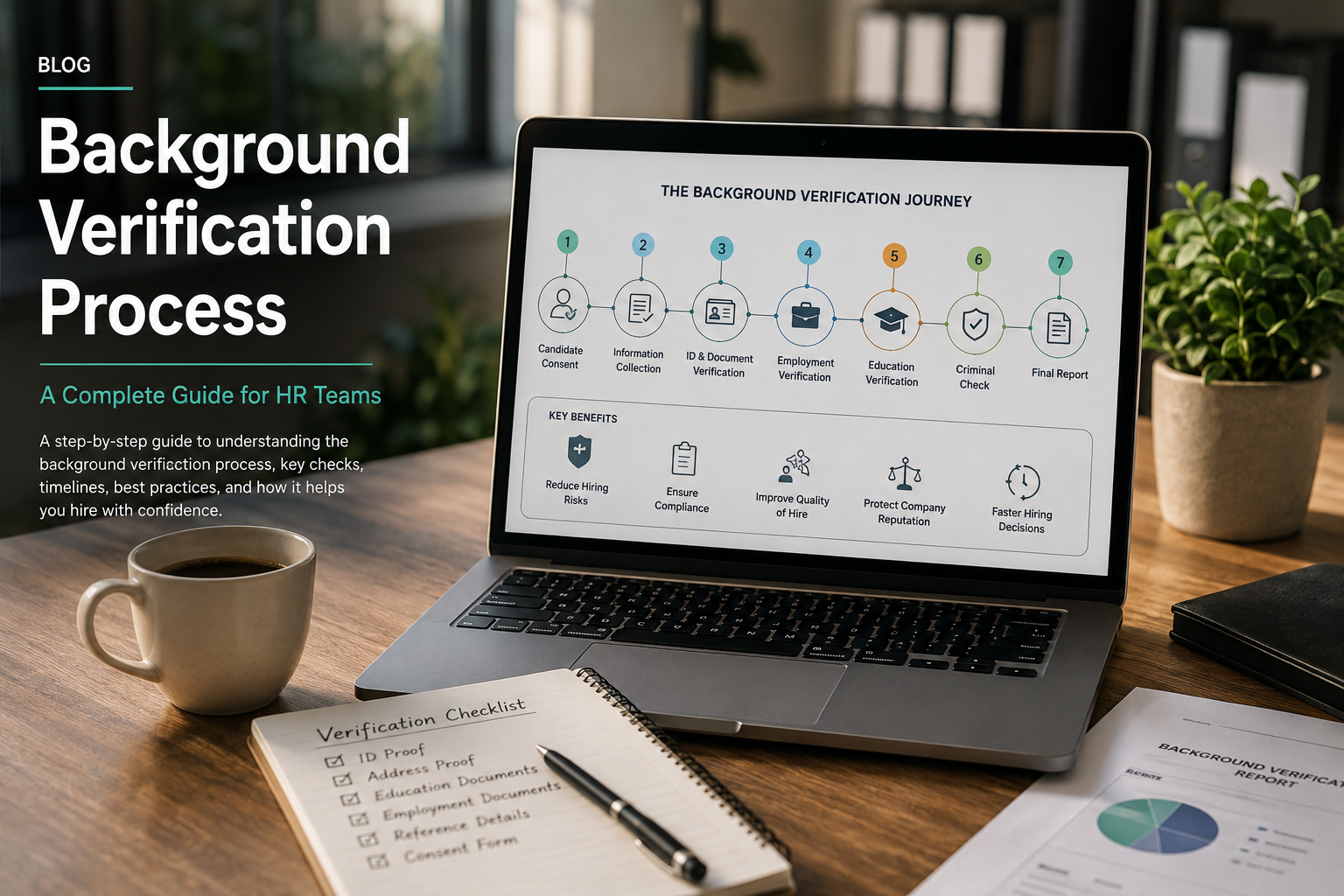
"Learn the complete background verification process with this in-depth HR guide. Discover every stage of employee background verification, including identity, education, employment, criminal, and address checks, along with timelines, compliance requirements, best practices, and AI-powered solutions to reduce hiring risks, improve accuracy, and make faster, more confident hiring decisions. Perfect for HR teams, recruiters, and enterprises looking to build a secure and compliant hiring process."
Background Verification Process: Complete Guide for HR Teams
Every wrong hire costs more than a salary. It costs onboarding time, team morale, client trust, and — in cases of falsified credentials or hidden criminal history — real organizational risk. That's why background verification (BGV) has moved from a "nice to have" to a non-negotiable step in modern hiring.
Yet many HR teams still run verification as a checkbox exercise: a form, a vendor, a "cleared" email, and nothing more. That approach leaves gaps. This guide breaks down exactly what a background verification process should look like, stage by stage, so your team can screen candidates thoroughly, fairly, and fast.
What Is Background Verification?
Background verification is the process of confirming that the information a candidate provides — identity, education, employment history, address, criminal record, and other credentials — is accurate before (or shortly after) they join an organization. It protects employers from negligent-hiring liability, protects existing employees and customers, and protects the integrity of the hiring decision itself.
It is not the same as a credit check, a reference call, or a LinkedIn scan. A proper BGV process is systematic, documented, and consent-based, and it typically runs through a specialized verification partner rather than being handled ad hoc by a recruiter.
Why Background Verification Matters for HR Teams
Resume misrepresentation is far more common than most hiring managers assume, and it spans everything from inflated job titles to fabricated degrees. A structured verification process gives HR three things an interview alone cannot:
- Risk reduction — catching falsified credentials, undisclosed criminal history, or identity fraud before they become the company's problem.
- Compliance — meeting industry-specific and regulatory screening requirements (finance, healthcare, and government roles especially).
- Defensibility — a documented, consistent process protects the organization if a hiring decision is ever challenged.
The Background Verification Process: Step by Step
1. Define the Screening Policy
Before any candidate is screened, HR and legal should agree on what gets checked for which roles. A warehouse associate and a finance controller don't need the same depth of screening. Document this policy once, apply it consistently, and revisit it annually.
2. Obtain Candidate Consent
Verification cannot legally begin without the candidate's informed, written consent. This step should clearly disclose what will be checked, which third party will conduct the check, and how the data will be used and stored. Skipping or rushing this step is the single most common compliance mistake HR teams make.
3. Collect Candidate Information and Documents
The candidate submits identity documents, education certificates, past employment details, and address proof — usually through a digital portal rather than email attachments, which reduces both turnaround time and document-handling risk.
4. Identity Verification
This confirms the candidate is who they claim to be, using government-issued ID validation (in India, typically Aadhaar, PAN, passport, or voter ID) matched against the details provided in the application.
5. Education Verification
The verification partner contacts the issuing university, board, or institution directly to confirm degree, dates of attendance, and — where relevant — grades. This step alone catches a meaningful share of resume fraud, since fabricated or "instant" degrees are one of the most common misrepresentations.
6. Employment Verification
Previous employers (usually HR departments, not the manager the candidate worked under) confirm job title, dates of employment, and sometimes reason for leaving. This checks for gaps, inflated titles, and fabricated tenures.
7. Address Verification
Confirms the candidate's current or permanent address, done either digitally through document matching or physically through a field visit, depending on the role's risk level.
8. Criminal Record Check
Searches court records and police databases at the district, state, or national level (and internationally, where the candidate has lived or worked abroad) for criminal history relevant to employment eligibility.
9. Additional Checks (Role-Dependent)
Depending on the position, this can include reference checks, credit history review, professional license verification, social media screening, drug or substance testing, and global/international verification for candidates with an overseas work history.
10. Report Compilation and Adjudication
The verification partner compiles findings into a report, typically flagging each item as "verified," "discrepancy found," or "unable to verify." HR then adjudicates: minor discrepancies (a slightly wrong job title) are treated differently than major red flags (fabricated degree, undisclosed criminal record).
11. Candidate Communication
If a discrepancy affects the hiring decision, most jurisdictions require the candidate be informed and given a chance to respond before the offer is withdrawn — this is both a compliance requirement and a fairness safeguard.
How Long Does Background Verification Take?
Most standard checks (identity, education, employment, address) complete within 3–7 business days when handled by a technology-driven verification partner. International verification, court record checks in certain jurisdictions, or unresponsive former employers can extend this to 2–3 weeks. Building buffer time into the offer-to-joining window prevents BGV delays from holding up onboarding.
Common Background Verification Challenges HR Teams Face
| Challenge | Why It Happens | How to Address It |
|---|---|---|
| Slow employer responses | Former employers deprioritize verification requests | Use a partner with an employer-outreach system and escalation process |
| Inconsistent screening depth | No formal policy by role type | Define and document a tiered screening policy |
| Candidate drop-off mid-process | Verification portal is confusing or slow | Choose a mobile-friendly, self-service candidate portal |
| Data privacy concerns | Sensitive documents handled insecurely | Confirm your vendor's data security certifications (ISO 27001, SOC 2, GDPR-readiness) |
| Discrepancy handling disputes | No standard adjudication process | Set clear severity tiers before screening begins, not after a flag appears |
Legal and Compliance Considerations
Background verification sits at the intersection of employment law and data privacy law, and requirements vary significantly by country and, within India, can involve state-level nuances for police verification. HR teams should ensure their process includes explicit candidate consent, purpose-limited data use, secure storage and eventual deletion of sensitive documents, and a fair-chance process for candidates who dispute a finding. Because these requirements change and vary by jurisdiction, HR teams should confirm current obligations with legal counsel or a verification partner with compliance expertise, rather than relying on a template consent form alone.
How to Choose a Background Verification Partner
Not all BGV vendors are equal. When evaluating a partner, HR teams should look at:
- Coverage — can they verify education and employment records across all the geographies your candidates come from, including internationally if relevant?
- Turnaround time — what's the average completion time for standard vs. complex checks?
- Technology — is there a self-service candidate portal, real-time status tracking, and API/ATS integration, or does everything run through email?
- Data security — what certifications (ISO 27001, SOC 2, GDPR compliance) back their data handling?
- Direct-source verification — do they verify directly with issuing institutions and employers, or rely on database matching alone?
- Support — is there a responsive team to handle escalations, disputes, and unusual cases?
Building a Verification-Ready HR Process
A strong background verification process isn't just about catching bad actors — it's about giving HR teams the confidence to make faster, better-informed hiring decisions. The most effective approach combines a clear internal policy, informed candidate consent, and a technology-enabled verification partner capable of handling checks at scale without sacrificing accuracy.
Frequently Asked Questions
What does a standard background verification check include? A standard check typically covers identity verification, education verification, employment history, address verification, and a criminal record check. Additional checks are added based on role risk and industry requirements.
Is candidate consent required for background verification? Yes. Written, informed consent from the candidate is a legal requirement before any verification check begins, and it should disclose what will be checked and by whom.
How long does a background check take? Standard checks generally take 3–7 business days. International verification or court-record checks in certain jurisdictions can take longer.
Can a job offer be withdrawn based on a background check? Yes, if a verified discrepancy is material to the role — but candidates should typically be informed of the finding and given an opportunity to respond before a final decision is made.
What's the difference between pre-employment and post-employment verification? Pre-employment verification happens before or immediately after an offer is made. Post-employment or periodic verification is an ongoing check run on existing employees, often used for roles with elevated trust or compliance requirements.
Appexigo helps HR teams run fast, accurate, and compliant background verification — from identity and education checks to global screening across 100+ countries. Book a demo to see how it fits into your hiring workflow.