Pre-Hire vs Post-Hire Verification: Which Risks Are You Missing?
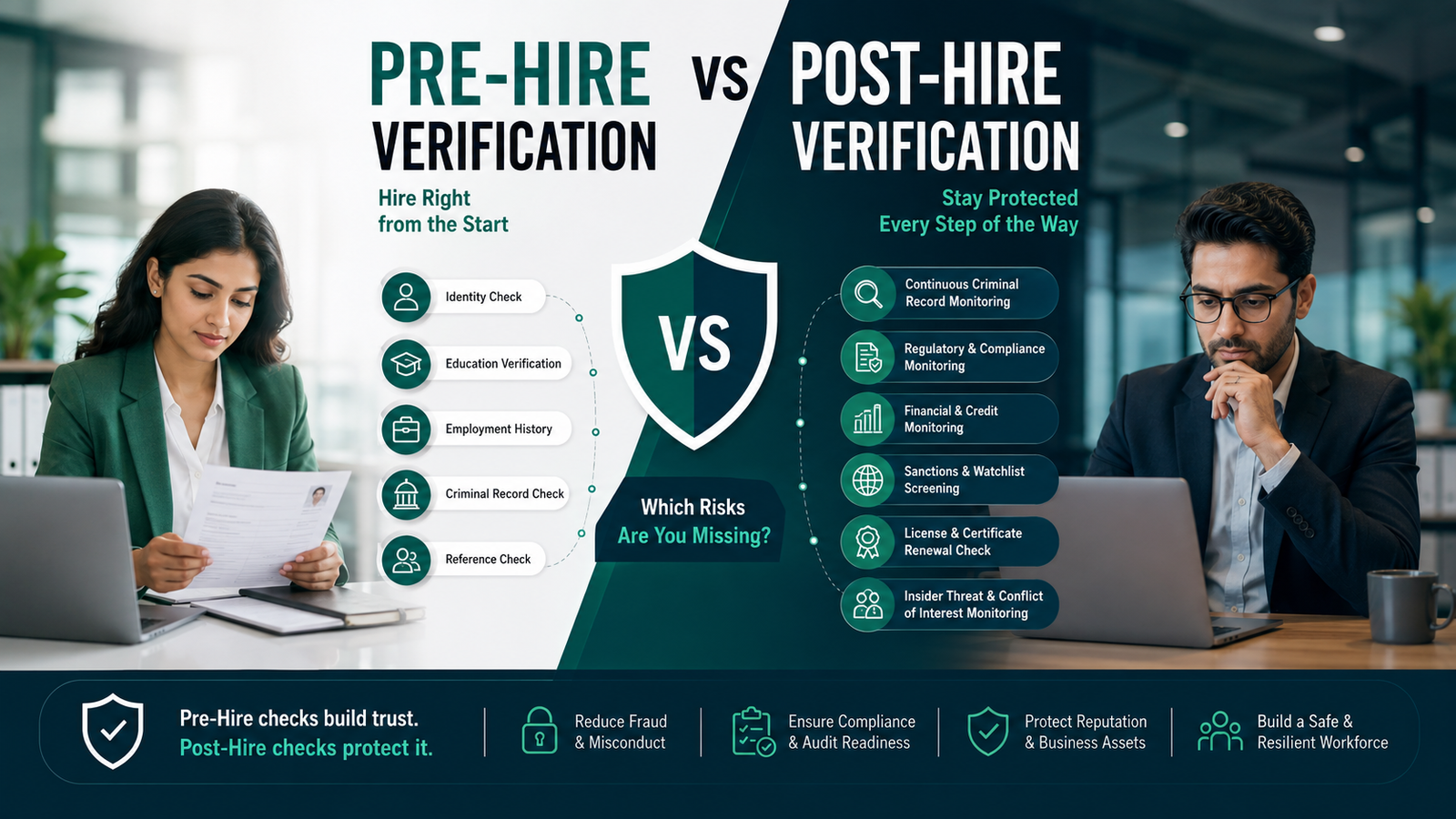
"Pre-hire verification helps organizations make informed hiring decisions by validating a candidate's identity, qualifications, employment history, and other credentials before onboarding. However, employee-related risks can emerge after hiring, making post-hire verification equally important. Periodic background checks, compliance monitoring, and continuous screening help organizations identify evolving risks, protect sensitive data, and meet regulatory requirements. "
Pre-Hire vs Post-Hire Verification: Which Risks Are You Missing?
Hiring the right candidate is only the first step in building a trustworthy workforce.
Many organizations invest heavily in pre-hire background verification, believing that once an employee clears the screening process, the risk is eliminated. Unfortunately, that's not always true.
Employee risks can evolve over time. A clean background at the time of hiring doesn't guarantee future compliance, ethical conduct, or financial integrity. This is where post-hire verification becomes equally important.
The question isn't Pre-Hire vs Post-Hire Verification.
The real question is:
Are you protecting your organization throughout the employee lifecycle?
Understanding Pre-Hire Verification
Pre-hire verification is conducted before a candidate officially joins the organization. Its objective is to validate the authenticity of the information shared during recruitment.
Typical checks include:
- Identity Verification
- Address Verification
- Employment Verification
- Education Verification
- Criminal Record Check
- Court Record Search
- Credit History (role-dependent)
- Reference Checks
- Professional License Verification
- Global Sanctions & Watchlist Screening
What Risks Does It Prevent?
Pre-hire verification helps organizations detect:
- Fake resumes
- False employment history
- Fake educational qualifications
- Identity fraud
- Criminal backgrounds
- Financial misconduct (for sensitive roles)
- Regulatory compliance violations
By identifying these issues early, employers reduce hiring mistakes and avoid reputational damage.
Understanding Post-Hire Verification
Post-hire verification refers to periodic or event-based background checks conducted after an employee has joined the organization.
Instead of validating past information, it focuses on monitoring emerging risks that may impact the organization.
Examples include:
- Periodic Criminal Record Checks
- Regulatory Compliance Screening
- Financial Risk Monitoring
- Conflict of Interest Checks
- Sanctions List Monitoring
- Social Media Risk Assessment (where legally permitted)
- Professional License Renewal Verification
- Vendor & Third-Party Affiliation Checks
- Continuous Identity Monitoring
This approach is becoming increasingly important in industries handling sensitive customer data, financial transactions, healthcare records, government projects, and critical infrastructure.
Risks That Pre-Hire Verification Cannot Detect
Even the most comprehensive pre-employment screening has limitations.
Here are risks that can develop after onboarding:
1. Financial Distress
Employees handling sensitive financial information may later experience financial difficulties that increase fraud risk.
2. Criminal Activity After Employment
A candidate may have a clean record during hiring but could face legal issues years later.
3. Regulatory Non-Compliance
Professionals requiring certifications or licenses may fail to renew them, exposing organizations to compliance violations.
4. Insider Threats
Disgruntled employees, privilege misuse, data theft, or intellectual property leakage often emerge during employment—not before it.
5. Conflict of Interest
Employees may start businesses, join competitors, or establish relationships that conflict with company policies.
6. Sanctions or Watchlist Inclusion
Global sanctions and regulatory lists are updated regularly. Employees who were compliant during hiring may later appear on restricted lists.
Industries That Benefit Most from Post-Hire Verification
While every organization can benefit, post-hire verification is especially valuable in:
- Banking & Financial Services
- Healthcare
- IT & Technology
- Government Contractors
- Manufacturing
- Logistics
- Aviation
- Education
- Pharma & Life Sciences
- Global Capability Centers (GCCs)
- BPO & Shared Service Centers
These sectors often operate under strict regulatory requirements and manage sensitive data, making continuous workforce screening an essential part of risk management.
Why Leading Enterprises Are Adopting Continuous Verification
Modern organizations are shifting from one-time background checks to continuous workforce monitoring because risk doesn't end on Day One.
Continuous verification enables organizations to:
- Detect emerging compliance risks early
- Strengthen governance and audit readiness
- Protect customer and organizational data
- Reduce insider threats
- Maintain regulatory compliance
- Build stakeholder trust
- Support secure digital transformation
As hiring becomes increasingly global and remote, continuous verification provides greater visibility across the employee lifecycle.
Best Practices for Implementing Both Verification Models
Organizations should consider a layered approach:
Before Hiring
- Verify identity and address
- Validate employment history
- Confirm educational qualifications
- Conduct criminal record checks
- Screen sanctions and watchlists
- Perform role-specific checks
After Hiring
- Schedule periodic background re-screening
- Monitor regulatory watchlists
- Verify license renewals
- Conduct compliance-based checks for sensitive roles
- Screen third-party/vendor relationships where applicable
- Review high-risk positions more frequently
This balanced strategy helps organizations manage both hiring risks and ongoing workforce risks.
The Future of Background Verification
The future of employee screening is moving beyond one-time verification.
Organizations are increasingly adopting:
- AI-powered verification workflows
- Continuous risk monitoring
- Automated compliance alerts
- Digital identity verification
- Real-time regulatory screening
- Secure verification platforms integrated with HR systems
These advancements enable faster decision-making while improving accuracy and compliance.
Conclusion
Pre-hire verification helps organizations make informed hiring decisions by validating a candidate's background before employment begins. However, it offers only a snapshot in time.
Post-hire verification extends protection beyond onboarding by identifying risks that may emerge throughout an employee's tenure.
Rather than choosing one over the other, organizations should view both as essential components of a comprehensive workforce risk management strategy. Combining pre-hire and post-hire verification enables businesses to reduce fraud, strengthen compliance, safeguard sensitive assets, and build a more resilient workforce.
In today's evolving risk landscape, verification is no longer just a hiring requirement—it's a continuous commitment to organizational trust and security.