How Fake Experience Fraud Works: A Complete Guide for HR Teams
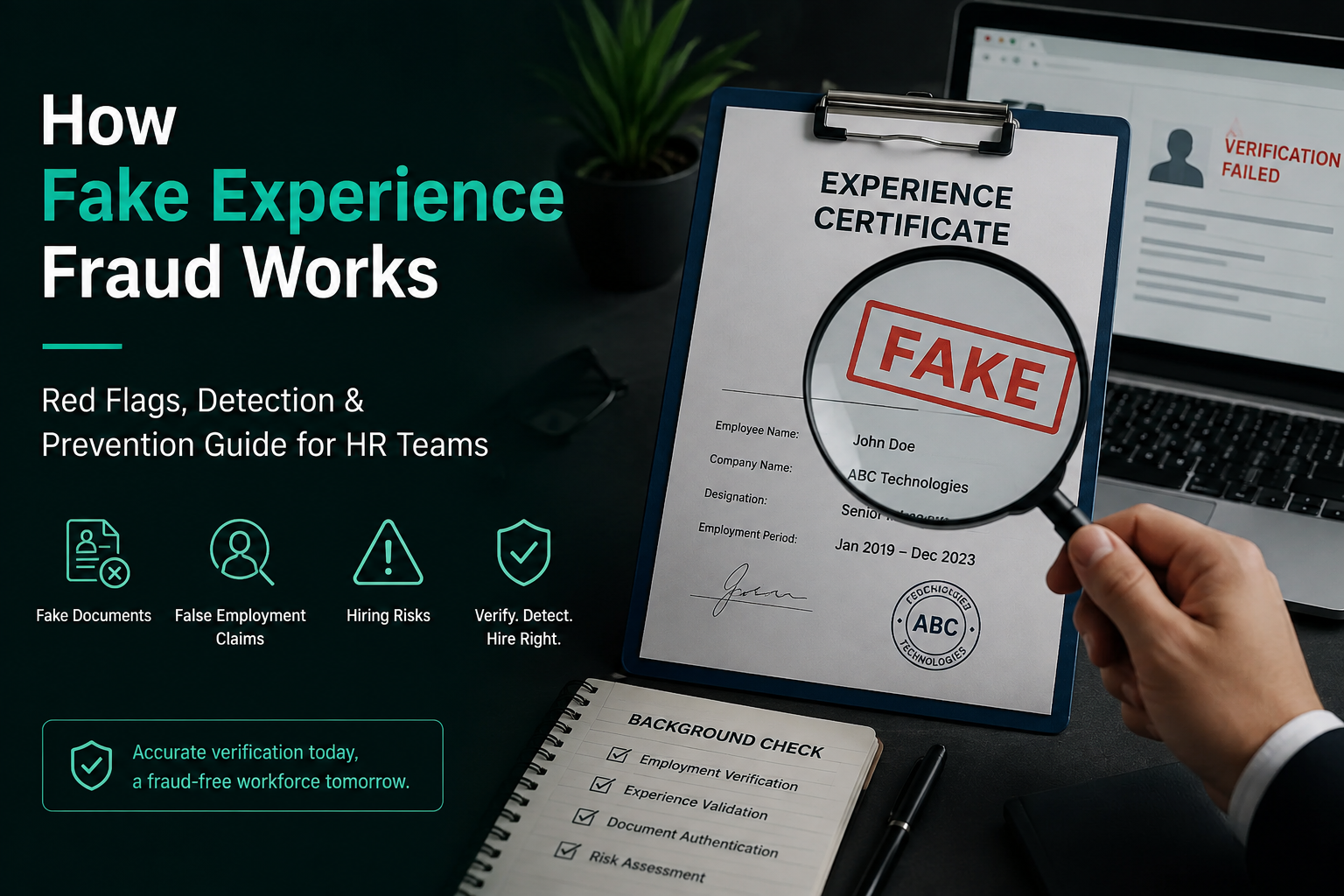
"Fake experience fraud is becoming one of the biggest challenges in modern hiring. Learn how fraudulent candidates create fake employment records, the warning signs HR teams should watch for, and how effective employment verification helps organizations detect and prevent hiring fraud before it impacts their business."
How Fake Experience Fraud Works: The Hidden Hiring Risk Every HR Team Should Know
Introduction
Hiring the right talent has become increasingly challenging in today's competitive job market. While organizations invest heavily in recruitment technology and interview processes, one growing threat continues to undermine hiring decisions—fake experience fraud.
Across industries, fabricated employment histories, forged documents, and fake employer references are helping unqualified candidates secure positions they never legitimately earned. These fraudulent profiles often look convincing enough to pass basic document verification, making them difficult to detect without a structured background verification process.
Understanding how fake experience fraud operates is the first step toward protecting your organization from costly hiring mistakes.
What Is Fake Experience Fraud?
Fake experience fraud occurs when a candidate intentionally misrepresents previous employment by creating or purchasing fabricated work history.
Rather than exaggerating responsibilities, these individuals often present entirely false employment records supported by forged documents and fake references designed to deceive recruiters.
The objective is simple:
- Qualify for higher-paying roles
- Bypass experience requirements
- Gain access to sensitive organizational systems
- Build credibility using fabricated career history
Without proper verification, these candidates may successfully enter organizations despite lacking the required skills or experience.
How Fake Experience Fraud Typically Works
A fraudulent employment profile often follows a predictable pattern.
Step 1: Purchasing a Fake Experience Package
Instead of gaining legitimate work experience, candidates purchase ready-made employment packages from fraud networks that specialize in creating believable employment histories.
These packages often include everything needed to support a fake profile.
Step 2: Generating Fake Employment Documents
The package usually contains professionally designed documents such as:
- Offer Letters
- Appointment Letters
- Experience Certificates
- Relieving Letters
- Employment Confirmation Letters
Many of these documents closely resemble genuine corporate formats, complete with logos, signatures, and company branding.
Step 3: Creating Supporting Salary Records
To strengthen the fabricated profile, additional documents are generated:
- Salary slips
- Bank statements (in some cases)
- Form-16 copies
- Employment certificates
- Increment letters
These supporting records create an illusion of long-term employment.
Step 4: Assigning a Fake HR Contact
Perhaps the most deceptive element is the fake reference.
Fraud providers often assign:
- Fake HR executives
- Fake managers
- Dedicated phone numbers
- Controlled email addresses
When verification teams call these contacts, the individual confirms every detail as if representing the company.
Step 5: Passing Basic Employment Verification
Organizations that rely only on candidate-provided references may unknowingly verify information with the fraudsters themselves.
Since the fake HR contact confirms the employment, the verification appears successful.
Step 6: Successfully Clearing Recruitment
If deeper validation is not performed, the candidate proceeds through onboarding and joins the organization.
At first glance, every document appears genuine.
The deception often remains hidden until operational issues, compliance audits, or internal investigations uncover inconsistencies.
Why Traditional Verification Sometimes Fails
Many organizations still depend on document-based verification or candidate-provided references.
Unfortunately, documents alone rarely prove employment authenticity.
Modern document editing tools, AI-generated content, and commercially available templates make it easier than ever to produce convincing employment records.
Without independent employer validation, even experienced recruiters may struggle to identify fraudulent profiles.
Red Flags HR Teams Should Watch For
While every case is unique, multiple warning signs deserve closer investigation.
Generic Email Domains
Professional organizations typically use official corporate email domains.
References responding from free email services may require additional validation.
Inconsistent Branding
Look for:
- Different logos
- Font inconsistencies
- Low-quality formatting
- Mismatched company addresses
- Signature irregularities
Professional organizations generally maintain consistent document standards.
Employment Date Mismatches
Compare dates across:
- Resume
- Offer letter
- Salary slips
- Experience certificate
- Relieving letter
Small inconsistencies often indicate document fabrication.
Unrealistic Salary Progression
Rapid salary increases without corresponding promotions or role changes should prompt further review.
The compensation history should align with industry standards and the candidate's career progression.
Recently Created Company Websites
Some fake employers create websites solely to support fraudulent verification.
Verify:
- Domain age
- Business history
- Company registration
- Physical office locations
- Digital credibility
A newly created website with limited business activity deserves additional scrutiny.
Missing Statutory Registrations
Legitimate organizations generally maintain statutory registrations such as tax and business registration records.
Missing or unverifiable registrations can indicate a fabricated organization.
Unverifiable Reference Numbers
Experience letters often contain employee IDs, reference numbers, or certificate numbers.
These should be independently verifiable wherever possible.
Minimal Digital Presence
Legitimate employers typically leave a digital footprint.
Look for:
- Professional website
- LinkedIn company page
- Employee profiles
- Business directories
- News mentions
- Client references
A complete absence of online presence may be a warning sign.
One Red Flag Doesn't Mean Fraud
It's important to avoid making hiring decisions based on a single inconsistency.
For example:
- Startups may have limited online visibility.
- Small businesses may use simpler documentation.
- Companies undergoing rebranding may have inconsistent templates.
However, when multiple warning signs appear together, HR teams should conduct a more detailed background verification before proceeding.
The goal is not to reject candidates prematurely but to verify employment independently and objectively.
Best Practices for Preventing Fake Experience Fraud
Organizations can significantly reduce hiring risk by implementing structured employment verification processes.
Recommended practices include:
- Verify employers independently instead of relying only on candidate-provided contacts.
- Cross-check employment records across multiple sources.
- Validate company legitimacy before confirming employment.
- Review salary progression for consistency.
- Examine document authenticity and formatting.
- Use technology-assisted background verification where appropriate.
- Maintain standardized verification procedures across all hiring teams.
A consistent verification framework helps reduce fraud while ensuring fair evaluation of every candidate.
Final Thoughts
Fake experience fraud has evolved beyond forged certificates. Today's fraudulent profiles often include convincing documentation, fabricated salary records, controlled HR references, and professionally designed company identities.
Organizations that rely solely on paperwork risk onboarding candidates whose experience cannot be independently validated.
Effective employment verification goes beyond checking documents—it verifies the employer, confirms employment through trusted sources, and identifies inconsistencies before they become business risks.
As hiring fraud becomes increasingly sophisticated, a robust background verification process is no longer just a compliance requirement; it is an essential part of responsible hiring.
Frequently Asked Questions (FAQs)
Can fake experience documents look genuine?
Yes. Modern editing tools allow fraudsters to create highly convincing offer letters, salary slips, experience certificates, and relieving letters. Document appearance alone should never be treated as proof of employment.
Is one inconsistency enough to reject a candidate?
Not necessarily. A single inconsistency may have a legitimate explanation. Multiple red flags, however, should trigger a more detailed verification process.
Why should employers verify the company instead of only the candidate?
Fraudsters often provide fake HR contacts and controlled references. Independent employer verification helps ensure that the employment history is genuine and not self-confirmed.
What is the biggest risk of hiring someone with fake experience?
Beyond productivity concerns, organizations may face compliance issues, financial losses, security risks, reputational damage, and reduced trust within teams if fraudulent hires gain access to critical systems.